Why a Workflow Matters When You Read Tarot Cards for Yourself
If you have ever pulled a single card, glanced at the guidebook, and tried to bend your situation into a yes-or-no answer, you have probably noticed the discomfort that follows. The card felt loud, the reading felt thin, and you ended the session more anxious than you started. That is a predictable failure mode of self-reading, and it has very little to do with the deck.
The problem is the missing process. A self-reading without a process tends to collapse into a single move: find a meaning that fits what you already hope is true. That move is hard to notice from the inside, which is exactly why a simple workflow helps. A workflow gives you permission to pause at each step, and pausing is where the reflective value of tarot actually lives.
The four steps we will use throughout this article are observe, interpret, question, and verify. They are deliberately slow. They are also deliberately limited: tarot is not a prediction, and the workflow is built around that limit. Two cards from the Major Arcana — The Hermit and Justice — will serve as our working examples. Both are well suited to a calm, evidence-aware approach, and neither one pretends to forecast anything.
A second benefit of a workflow is that it lowers the stakes. Once a tarot reading becomes a low-stakes habit, you can use it for ordinary questions — how you spent your week, whether a small choice aligns with your schedule, what kind of attention a situation deserves — without dragging every shuffle into crisis territory. For serious concerns involving medical, legal, financial, safety, or crisis decisions, you should rely on qualified professionals and direct evidence first, and treat tarot, at most, as a private journaling aid that supports self-reflection.
Step One: Observe What the Image Actually Shows
The first step is also the easiest to skip, which is why we put it first. Before you read a single keyword, look at the card. Describe what you actually see, in plain language, on paper or in a notes app. Three short observations are enough.
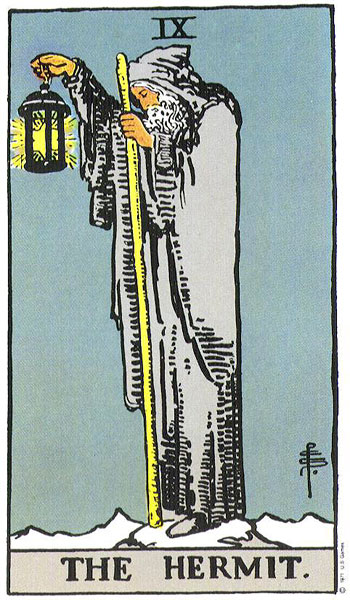
The Hermit shows a cloaked figure standing alone, often on a peak, with a lantern held up in one hand and a staff in the other. Justice shows a seated figure framed by two pillars, holding a sword upright and a set of scales. Both images are unusually legible, which makes them good teachers.
For The Hermit, three observations might look like this:
- The figure is alone in the picture. No companion, no crowd. - The lantern is small but lit. The light is contained, not flooding the scene. - The figure faces slightly to the side rather than directly out at the viewer.
For Justice, three observations might look like this:
- The scales appear empty, or close to it. Nothing obvious is weighing them down. - The sword points up rather than down. The posture is vertical and centered. - The figure sits between two pillars, suggesting a threshold or a frame.
The point of these observations is not to be clever. It is to anchor your reading in something you can point to. If your later interpretation contradicts what is plainly in the image, that is a signal to slow down, not to argue with the card.
You will also want to record orientation. If The Hermit appears reversed, write that down before reading the meaning. If Justice is upright, write that down too. Orientation is data, not a verdict.
Step Two: Choose Interpretations Without Forcing Them
Now, and only now, you can look at the meanings. But the rule is to list more than one plausible interpretation before committing to any of them. Forcing an answer usually means picking the first meaning that flatters your hopes, and then defending it.
For The Hermit upright, the working keywords are deliberate withdrawal, careful inquiry, and creating enough quiet to identify your own position. Plausible interpretations might include:
- A reminder to step back from a noisy week and protect some unstructured time. - A nudge to research a decision more carefully before committing to it. - A suggestion that a question you have been discussing openly might serve you better if held privately for a while.
For Justice upright, the working keywords are evidence, accountability, proportion, and a decision that can withstand careful examination. Plausible interpretations might include:
- A prompt to weigh pros and cons on paper before acting. - A check on whether your current position rests on facts or on assumptions. - An invitation to hold yourself to a standard you would accept from someone else.
The reversed orientations matter too. The Hermit reversed can signal that solitude has drifted into isolation, or that reflection is starting to delay a conversation that genuinely needs to happen. Justice reversed can signal that relevant information is missing, that responsibility has been displaced, or that a standard is being applied unevenly. Reversed cards are not omens of doom. They are usually a reminder to look at the same theme from a slightly off-center angle.
Pick the interpretation that is best supported by your three observations. If none of them really fits, write that down. A clean mismatch is more useful than a forced match, because it tells you something honest about the gap between your situation and the card.
Step Three: Ask Questions the Cards Can and Cannot Answer
Tarot works best when it helps you ask better questions. It works worst when it tries to answer questions it has no business answering. This step is where most self-readings go off the rails, because the temptation to ask "what will happen" or "what does he think" is strong.
The Hermit offers a reflection prompt that is built for this step: "What question deserves uninterrupted thought, and when should that thought return to the world?" That is a question about the shape of your attention, not a question about the shape of your future.
Justice offers a parallel prompt: "What facts and consequences should be placed side by side before deciding?" That is a question about your evidence-gathering process, not a verdict.
A useful way to apply both prompts at once is to rewrite the question you walked in with. If you came in asking "Should I take this project?", you can reframe it to "What does my actual week look like in hours, and which facts would I need before this question makes sense?" You have just turned a yes-or-no into a research plan, which is exactly what Justice asks of you and exactly what The Hermit gives you space to do.
Some questions are simply outside the workflow's scope. Questions about another person's inner state, hidden intentions, or romantic feelings tend to produce readings that flatter the asker and obscure the truth. Questions about health symptoms, legal exposure, financial commitments, or personal safety should go to qualified professionals and to direct evidence, not to a deck. Tarot can accompany journaling in those areas, but it should not be the deciding voice.
Step Four: Verify Against Your Journal and Outside Evidence
The fourth step is the one most readers quietly skip, and it is the one that keeps the practice honest. Verification does not mean asking the cards whether you got it right. It means writing down what you noticed, what you interpreted, and what question you walked away with, and then returning to the entry later to compare it with what actually happened.
A simple journal template is enough:
- Date, card or cards drawn, and orientation. - Three observations of the image. - Two or three plausible interpretations, with the one you chose marked. - The reframed question you left the session with. - The outside evidence you would need to know whether your chosen interpretation was right.
The phrase to hold onto during verification is this: record ambiguity and disconfirming evidence as carefully as an apparent match. If Justice suggested that your decision rested on solid evidence and a week later you realize a key number was wrong, you write that down alongside any moments that fit. You do not edit the entry to make the reading look more accurate than it was. The journal is a record of your thinking at a moment in time, not a defense of the cards.
A practical rhythm is to leave a few days between the reading and the verification. Long enough for reality to settle, short enough that you remember what you were actually considering.
A Low-Stakes Example Using The Hermit and Justice
To make the workflow tangible, consider a routine situation. You are weighing whether to volunteer for a small project at work. Nothing urgent, no crisis — just a familiar kind of trade-off between effort and opportunity.
You sit down with a single card or a small spread. You draw The Hermit upright and Justice upright. Following the workflow, you start with observation. The Hermit's figure stands alone with a small lit lantern, looking to the side rather than at you. Justice's scales appear empty and level, the sword pointing up, the figure seated squarely between two pillars.
You move to interpretation. For The Hermit, three candidates come to mind: step back from the noise of the week, do more research before committing, or hold the question privately for a few more days. For Justice, the candidates are: weigh pros and cons on paper, check whether your assumption about time is realistic, or hold yourself to the same standard you would apply to a colleague.
You notice that two interpretations rhyme with each other — both cards are pointing toward checking facts before deciding. That is a useful signal, not a guarantee. It is a sign that verification might be the most honest next move.
You move to questions. The Hermit prompt reframes your original question into something like, "What does this choice look like if I sit with it quietly for a couple of days?" Justice reframes it into, "What are the actual facts about my time and energy this month, set side by side with what this project would require?"
You leave the reading with a research plan rather than a verdict. A few days later, you check your calendar and discover that two of the next three weeks are already heavily booked. You decline politely, and you write that down in the verification section of your journal entry.
Notice what the cards did and did not do. They did not predict the outcome. They did not tell you to say yes or no. They did not reveal what your colleagues are thinking. They prompted a structured reflection that surfaced a missing fact — your actual schedule — and they did it without ever claiming to know the future.
When Tarot Stops Being Useful, and What to Do Next
A workflow is useful only as long as you can follow it. There are a few signs that the practice has slipped, and they are worth naming plainly.
If you are pulling cards compulsively, asking the same question in slightly different forms over and over, treating reversals as warnings of doom, or using readings to avoid a conversation you need to have, the workflow has broken. So has the practice. Step back, take a break, and return only when you can treat the cards as one tool among several rather than the deciding voice.
If a question involves medical decisions, legal exposure, financial commitments, personal safety, or any kind of crisis, treat tarot as a journaling aid at most and rely on qualified professionals and direct evidence first. The cards have no special access to your health, your contracts, your money, or your danger. Real expertise and real evidence do.
When the practice is working, it should feel quieter than you expected. The point of learning how to read tarot cards for yourself is not to add a louder voice to your decisions. It is to develop a steadier one. A good self-reflection leaves you with a clearer question, a small list of facts to gather, and a calmer week. If a tarot reading leaves you more anxious than you started, the cards have not failed you. The workflow probably skipped a step, and that is a problem you can fix.
Share this article