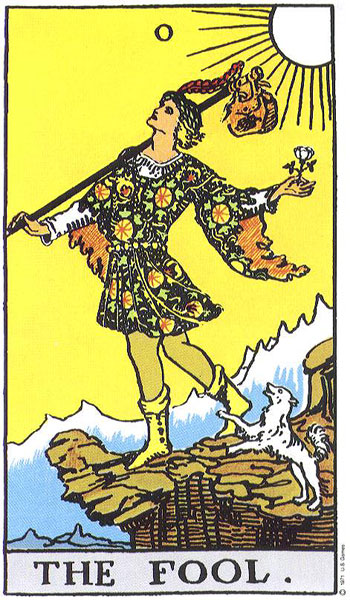
What the Card Actually Shows
When you sit with The Fool and look at the picture in front of you, the first thing to register is position. The card is numbered 0 and sits at the start of the Major Arcana, the section of the deck used for larger life themes. That placement already tells you something about how the card is framed in most reading traditions: a doorway rather than a destination.
Decks vary, and a serious interpreter pays attention to which deck they are using. Even so, several visual cues repeat often enough to count as a working vocabulary. You will frequently see a figure mid-stride, often looking up or forward rather than down at the path. A small bundle or satchel is typically carried lightly, suggesting portability rather than weight. The ground beneath the figure is often suggested as a cliff edge, a ledge, or an open horizon, with no visible road behind. A small companion is a common feature. The sky tends to be bright, with a large sun overhead. These cues are conventions rather than rules, and they are worth checking against the specific deck in your hand before you build a reading on top of them.
The keywords the editor has provided for this guide frame the card as a beginning, an experiment, and a step into unfamiliar territory. The tone is described as open. That word does meaningful work. Open is not the same as safe, and it is not the same as guaranteed. It suggests a posture rather than an outcome.
It helps to write down, before you read further, what you actually see in your specific card. A useful exercise is to spend one full minute naming three visual elements without yet assigning them meaning. The hand on the satchel. The angle of the head. The brightness at the top of the frame. None of these are loaded with destiny. They are observations, and the interpretive work that comes later should remain reversible.
The Upright Fool in Plain Language
A common search for the fool tarot card meaning pulls up dramatic language about destiny and leaps of faith. The grounded version is quieter. Across upright and reversed readings, the card's anchor remains the same: new beginnings asked to grow with awareness. Upright, The Fool is most commonly described as a beginning, an experiment, or a step into unfamiliar territory, and that is the phrasing this guide uses because it is what the supplied card data offers.
The temptation in any reading is to translate a small word like "beginning" into something much larger, such as "your whole life is about to change." That translation is exactly the leap the upright card warns against.
A practical way to read the upright Fool is to treat it as a permission slip paired with a small caution. You are allowed to begin. You are not promised success. Curiosity is honored, and so is the discipline of staying curious without confusing it with certainty.
A few features of the upright reading are worth naming so you can test them later. First, the upright Fool tends to highlight what is new rather than what is familiar. If nothing in your situation is new, the card may be pointing at a part you have stopped looking at, or it may be a poor fit for the question you asked. Second, the upright Fool usually suggests a posture of learning rather than a posture of deciding. If you feel pushed to make a final choice when the card appears, that mismatch is information. Third, the upright Fool often pairs well with small, low-cost actions: a conversation, a draft, a trial run, a one-week test. Large commitments can still happen, but they are downstream of small ones, not the first move.
The Reversed Fool: Pause Before the Leap
Reversed, the card points to a beginning that may need more preparation, clearer boundaries, or sharper awareness of consequences. The reversal does not flip the upright meaning into its opposite. It shifts the same energy from open curiosity into a request for grounding.
The reversed Fool often shows up when a reader is excited about an idea and has skipped a step. Common patterns include acting on impulse without naming a budget, telling friends about a plan before checking the basic facts, or signing up for something because it feels right in the moment. None of these are automatically wrong. They are simply situations where the upright "open and curious" energy has outrun the slower processes of preparation.
The reversed Fool also appears when a reader has been told that The Fool is reckless, and the reversal is read as a flat "do not be reckless." A calmer interpretation is that the reversed card asks whether your preparation matches the size of your choice. If the choice is small, light preparation is fine. If the choice touches your housing, your health, your finances, or another person's wellbeing, the reversed card is a request to slow down long enough to name what could go wrong and what you would do if it did.
A Grounded Example
Consider Maya, a thirty-four-year-old teacher who has been thinking about starting a small online course on a topic she knows well. She draws The Fool upright in the morning. She feels a rush of energy and spends the next two hours drafting a sales page, buying a domain, and announcing the project on social media. By evening she is exhausted and a little anxious. She has not confirmed that her target audience actually wants the course, and she has not checked whether her schedule can absorb the work.
A grounded reading would not predict success or failure for Maya. It would redirect her to the upright Fool's actual suggestions. Maya could test on a small scale: draft an outline, share it with three people in her target audience, ask whether they would pay for what she plans to teach, and notice their responses. She could define a small budget and a small time window. She could decide in advance what she would do if the test flopped, including the option of stopping. None of this drains the energy of the card. It channels it.
If Maya had drawn the reversed Fool, the same project would still be on the table, but the reading would suggest she sit with a few questions before going public. Has she checked the legal requirements for her region? Does she have a clear refund policy? Has she talked to one person who has done this before and learned from their mistakes? Reversed does not mean abandon. It means add the missing step before you leap.
Maya's example also shows the limits of any single card. The Fool alone cannot tell you whether the course will succeed. It can only suggest a posture, a pace, and a set of preparatory moves worth making.
Testing Your Reading Against Real Evidence
A useful rule in any reflective practice is to record a guess before you look at outcomes, then compare. The same rule applies here. When you draw The Fool, write down, in plain language, what you think the card is pointing toward in your situation. Be specific. "I think this means I should sign up for the workshop" is more useful than "something new is coming."
Then, over the following days or weeks, notice three kinds of evidence. The first is supporting evidence. Did anything happen that lined up with what you wrote? The second is disconfirming evidence. Did anything happen that cut against your reading, or that simply did not match? The third is ambiguity. Were there events you cannot cleanly assign to either side? A serious interpreter weights all three equally, and treats the disconfirming evidence with the same care as an apparent match.
Many readers unconsciously inflate supporting evidence because it feels good, and unconsciously downplay disconfirming evidence because it threatens the story they want to tell. A simple habit reduces this bias. After each event, ask: if I were wrong about the card, how would I explain what just happened? If your alternative explanation is at least as plausible as the card reading, the card has not yet earned your confidence.
This is also the place to say plainly what tarot is and what it is not. Tarot is a reflective tool. It is a structured way to ask yourself a question, to surface what you already suspect, and to slow down long enough to notice. It is not a prediction. It does not know the future. It cannot tell you what another person is thinking, feeling, or planning. When a reading seems to describe a future event in vivid detail, that vividness is a cue to slow down further, not to trust the reading more.
This matters even more in situations that carry real weight. For medical decisions, rely on qualified clinicians and the evidence they share with you. For legal questions, rely on licensed professionals in your jurisdiction. For financial moves above what you can comfortably lose, rely on regulated advisors and your own records. For safety or crisis moments, contact local emergency services, crisis lines, or people you trust in real life. A tarot card is a companion for reflection, not a substitute for expertise.
Journal Prompts to Verify Your Interpretation
A reading that stays only in your head tends to harden. A reading that meets paper tends to soften. The prompts below are designed to be answered in a journal, in your own handwriting if possible, within twenty-four hours of the reading. None of them require a special belief system. They require only that you write what you actually notice.
What did you see on the card before you read anything about it? List three visual elements without interpreting them. Now revisit your list and ask whether your interpretation was driven by the picture or by what you already wanted the card to say.
What is one small action you could take in the next seven days that would test the card's message at low cost? Define the test so that it could fail. A test that cannot fail tells you nothing.
What is one piece of disconfirming evidence you have ignored so far? Give it a fair hearing. If the disconfirming evidence is at least as strong as the confirming evidence, hold the reading lightly.
What would you need to see in the next month to revise or drop the interpretation? Naming this in advance makes it easier to act on later.
Who, if anyone, in your life would benefit from hearing about this decision before you act? The reversed Fool often points toward exactly this question.
If, after a month, the card's message has not been supported by anything you can name, let it go. A reflective tool earns its place by helping you see something you could not see before. When it stops doing that, set it aside without ceremony. You can always pick it up again tomorrow.
Share this article