Why Certainty-Seeking Questions Bias the Reading
When you sit down with a deck and the first thing you ask is, "Will I get the job?" or "Should I leave my relationship?" you are already shaping what counts as a meaningful answer. The question assumes the cards can deliver a verdict, and your attention narrows to anything that sounds like confirmation. This is the bias the practice of tarot questions and journaling is designed to address. The deck cannot tell you which way a future event will fall, and treating it as if it can invites you to ignore the much larger pool of evidence that would otherwise surround the decision: your calendar, your finances, your body's signals, the words of people who know you well.
A reflective question, by contrast, gives the image somewhere to point. Instead of "Will they call me back?" you might ask, "What part of this situation am I still not seeing?" The first question demands a yes or no from cards that have no opinion on your inbox. The second invites you to notice something you have been overlooking, which is what most readers actually want from a deck.
This shift is small in wording but large in effect. Certainty-seeking questions reward you for finding the card that matches the answer you already want. Open prompts reward you for the opposite, for recording what you notice before you interpret it. The cards do not push back when you load the question. Your journal can.
From Predictive Questions to Open Prompts
A useful open prompt has three properties. It describes a situation rather than a destination, it asks for something you can act on or observe, and it leaves room for the answer to be uncomfortable. "What does my week actually look like?" works because it invites you to check your calendar against your feelings. "Why is this happening to me?" almost never works, because it frames the cards as judges of fate and you as a defendant.
Good prompts also tend to use language that the cards can illustrate but not resolve. Words like pattern, patience, cost, timing, and balance let an image comment without commanding. A spread then becomes a mirror held up to a question, not a verdict on it.
When you reformulate, ask yourself: would I still want this answer if it contradicted what I hoped? If the honest answer is no, the question is still doing certainty work and should be rewritten. The same test applies to prompts about other people. "What is my colleague really thinking?" puts words into someone else's mouth that they never said. The honest version is "what part of this situation am I avoiding?" which is a question about you, and therefore one a journal can usefully hold.
A Morning-and-Evening Journal Template for Tarot Questions and Journaling
A consistent template is the heart of this practice. The point is not to fill pages. The point is to make misses visible, because the human memory edits out anything that did not fit the story you were already telling. When prompts and recording rules are the same from day to day, the practice can be checked against itself.
A morning entry, kept short, might look like this:
- **Date and prompt.** Write the open prompt you used, in full. - **Card or cards drawn.** Record the card, orientation, and a one-line description of what you literally saw in the image. - **What I noticed first.** Before interpreting, write what caught your eye, including colors, figures, expressions, and objects. This slows the leap to meaning. - **Possible meanings.** Two or three options, written as possibilities rather than conclusions. - **What I will watch for today.** One or two concrete, observable things you could check by evening.
An evening entry completes the loop:
- **What happened today, briefly.** Factual, neutral sentences. No spin. - **Did the cards' possible meanings show up?** For each possible meaning, mark yes, no, partial, or unclear. - **Disconfirming evidence.** Anything that pushed back against the reading. Write this before writing confirmations, so it gets equal attention. - **What I missed.** What the morning entry did not anticipate. - **Next prompt or revision.** Anything you want to reformulate.
The order matters. Recording what would have disproved the reading first protects you from the bias that comes from looking only for matches. Ambiguity is recorded as ambiguity, not folded into a tidy story.
A Low-Stakes Example With Three Cards
Suppose on a Tuesday you are wondering whether to attend a friend's housewarming on Saturday. You are mildly tired, the drive is an hour, and you do not yet know who else is coming. Instead of asking, "Will I regret going?" you draw three cards with the prompt: "What would help me decide this honestly?"
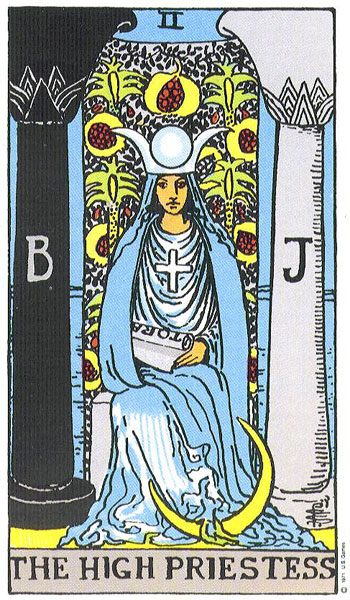
You draw The High Priestess, Temperance, and Judgement. Three Major Arcana cards is more weight than you might expect, and the prompt invites you to ask why rather than to obey.
First, write what you see. The High Priestess sits between two pillars, holding a scroll that in many decks is marked with the word TORA; in your deck she wears a blue robe and a crown shaped like an Isis knot. Temperance is an angel with two cups, pouring water between them in a way that never spills. Judgement shows an angel sounding a trumpet over figures rising from coffins or water below, often depicted with a banner that carries a cross.
Then, before interpreting, note what you noticed first. Perhaps you wrote: the High Priestess looks away from you rather than at you; the water in Temperance appears to be going downward in the lower cup and upward in the upper one at the same time; the figures in Judgement are not being dragged upward but raising themselves, hands open. These are observations, not conclusions.
Now write possible meanings. The High Priestess suggests incomplete information, which matches the fact that you do not know who is going. Temperance suggests calibration, which could mean anything from timing the drive to balancing introvert and extrovert needs. Judgement suggests review, which could be a reminder to look at the full week rather than this single event.
By evening, you check what actually happened. Perhaps you learned that one person you find draining will be there, and one person you enjoy will not. The reading did not predict this. It described a shape that the new information happens to fit, and it would have equally well described a different set of information. The journal entry records that as "partial," with a note about which pieces of the pattern did and did not appear.
If you had asked, "Will I regret going?" and drawn these three cards, you might have read Judgement as a warning and stayed home, or read The High Priestess as a signal of mystery and gone anyway, and either way you would have felt confirmed. The open prompt did not give you a better fortune. It gave you a better record, one that you can return to next week and learn from.
Recording Misses and Disconfirming Evidence
The hardest habit to build is writing down what did not fit. Confirmation bias is not a flaw of the tarot. It is a feature of how attention works. We remember the things that match and forget the things that do not, especially when the match supports a decision we already wanted to make. A journaling practice is meant to slow this down, not to fix it. The journal will still tilt toward confirmations unless you actively structure it otherwise.
A few practices make this easier. One is to set a reading before you know how the day will go, not after. Another is to write the predicted patterns in the morning and then, in the evening, score each one on a scale rather than a yes or no. A scale lets you record partial matches and avoids forcing a binary. A third is to share the journal with someone who is not invested in your reading and to ask them, simply, "What here looks like I am cherry-picking?"
The High Priestess, when drawn reversed in the deck you are working with, names this risk directly. Silence may be protecting avoidance, or an intuition may need testing against evidence. That is not a mystical claim. It is a description of how unexamined hunches harden into "I just knew." If your intuition does not survive being checked against real-world evidence, it is worth recording that it did not, in the same entry where you record that another hunch did. The journal holds both kinds of result with the same pen.
When the Cards Get It Wrong, and Why That Helps
A reflective practice expects misses. You will sometimes record that a card's possible meaning simply did not appear. That is information, not failure. It tells you which patterns you are good at noticing and which you tend to project. Over weeks, the journal becomes a map of your own interpretive habits, which is more useful than any single reading.
Temperance, drawn upright, names integration, calibration, and moderation. Drawn reversed in your deck, it suggests that a process may be out of proportion, rushed, or swinging between extremes, losing the moderation the upright card names. If you find yourself reading the same three cards to mean the same three things every morning, that may be the relevant message. The cards are not warning you about your life. They may be mirroring a practice that has gotten too rigid or too frequent, and the reflection worth writing down is about the practice itself.
Judgement, in upright form, asks what the complete record shows when you look beyond the latest event. This is the question that justifies the whole practice. Any single entry can flatter you. The full pattern, read with the same care you would give someone else's notes, cannot flatter you. It can only describe you.
Limits and When to Seek Real Help
It helps to say clearly what this practice is not. Tarot is not a prediction. It does not forecast outcomes, diagnose conditions, or speak for other people. If a question is about your health, your safety, your legal situation, your employment rights, or another person's intentions, the appropriate sources are qualified professionals, current evidence, and people you trust in real life. This article and the cards it describes are for reflection, not for making decisions that carry real consequences.
The same limit applies to questions about other people. Even an open prompt that uses language like "what is really going on here" can quickly become a claim about someone else's inner state. A useful rule of thumb is to write only what you could verify on your own, with your own evidence, before the end of the day.
If you are in crisis or feel unable to keep yourself safe, please reach out to local emergency services, a clinician, or a crisis line in your country. A reflective practice is meant to support a life you are already living, not to substitute for the help that life sometimes requires. The journal is a tool for noticing. The people and systems around you are the ones who can act.
Share this article