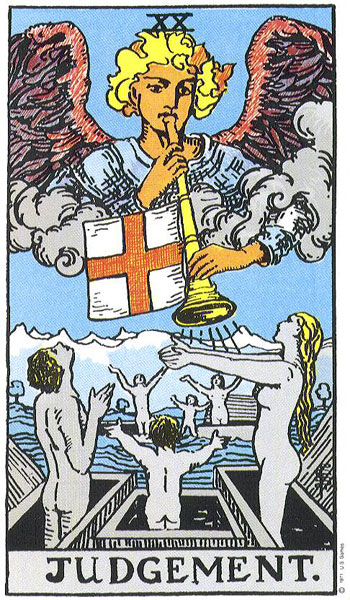
What the Card Shows: Observable Imagery
The Judgement card is the twentieth card of the Major Arcana. In most traditional decks, the image is busy with motion and sound: an archangelic figure hovers in the sky, often with large wings, blowing a trumpet. Below the trumpet, figures stand or rise, sometimes from coffins or from the water, with their arms lifted or crossed over their chests in a posture of attention. Behind them a mountain range rises, sometimes capped with snow, and a flag or banner is sometimes visible on the central peak. A sea or stretch of water tends to separate the rising figures from the angel.
Because the brief for this article focuses on the judgement tarot card meaning, it helps to begin with what is simply visible, rather than with symbolic interpretation. Looking carefully, you can usually describe:
- A trumpet or horn being blown from above. - A large winged figure, frequently named Gabriel in commentary, though the card itself does not always print a name. - A group of people reacting to the sound, with gestures that look surprised, attentive, or in the act of standing up. - An expansive landscape with mountains and water.
These visual features matter because interpretation is built on what is shown, not on what the reader hopes to see. If your deck is non-standard, take thirty seconds to write down what you actually notice before you read any meaning into it. The same disciplined habit is useful when you later turn the card into a decision prompt.
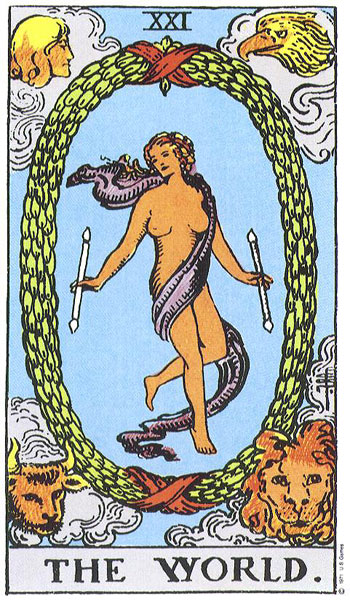
The number 20 matters too. In the Major Arcana, numbers are part of how cards relate to each other. Card 20 follows The Fool (0) at one end and The World (21) at the other, and it sits after The Sun (19). That ordering is a reminder that the card is positioned at a late stage of a long arc, which matches its theme of review rather than beginning.
Upright Judgement: Reflection Prompts for Review and Decision
When the card appears upright, the supplied data points toward review, reckoning, and a decision informed by the full pattern rather than one isolated moment. Three ideas sit inside that line.
First, "review" suggests looking back over a period, not a single event. Second, "reckoning" suggests weighing what you actually find, including parts you would rather not weigh. Third, "decision informed by the full pattern" suggests that the move you make next should rest on more than the loudest recent data point.
Reflection prompts for an upright appearance can include:
- What does the complete record show when you look beyond the latest event? - Which earlier chapter of this situation still influences how it feels today? - If I wrote a one-page summary of the past year of this area of life, what would honestly be on it? - What decision has been waiting for me to gather the full evidence rather than the most recent evidence? - What would I tell a friend in my exact position, and how does that differ from what I am telling myself?
It is worth noticing that "decision" here is treated as a verb the reader performs, not a verdict the card delivers. The upright appearance is an invitation to use the whole record. It is not a guarantee that the decision will feel easy or that the outcome will match the immediate wish.
Reversed Judgement: When Self-Judgment or Postponement Dominates
The reversed meaning the data gives is: self-judgment may be louder than evidence, or a needed evaluation may be repeatedly postponed. This is a useful two-part warning, because both halves show up in real life and they often appear in different weeks.
The first half, self-judgment louder than evidence, points to a pattern where the reader's inner commentary is harsher than the facts. You might be able to list three concrete wins from the past month, yet the dominant inner voice speaks only about the one unfinished task. That gap between record and self-talk is exactly what the reversed card is asking you to inspect.
The second half, postponed evaluation, points to a pattern where the needed reckoning keeps slipping. You keep meaning to look at the budget, the conversation, the application, or the health question, and the next quarter arrives before you have done it. The card is not predicting a consequence. It is naming a stalled process.
Reflection prompts for a reversed appearance can include:
- Where is my inner voice louder than the actual record would support? - What evaluation have I scheduled three times and rescheduled three times? - What would I need to write down to make the postponement harder to maintain? - Am I avoiding the review because of fear of the answer, or because I do not have a method for the review?
A useful habit is to write the postponement on paper with a small next step. "Look at bank statements for June" is more honest than "get my finances in order," and it is also testable later, which is the point.
A Grounded, Low-Stakes Example
To make the upright and reversed prompts easier to use, here is a low-stakes example that does not involve other people's motives or hidden knowledge.
Maya, a reader using this card for reflection, has been thinking about whether to renew a part-time class. She draws Judgement upright. Rather than treating it as a prediction, she takes it as a review prompt.
She writes a one-page summary. The full pattern shows: she enjoyed the first term, learned a useful skill, made one friend she still meets, and skipped the last three sessions because of fatigue, not because of disinterest. She also notes that the cost is non-trivial and that two of the skills she wanted are now available cheaper online. The record is mixed. The decision is not obvious.
She then asks the upright prompts. What does the complete record show? It shows two parts enthusiasm and one part logistics. What decision has been waiting for the full evidence? A clear-eyed choice between renewing and switching to the cheaper online option for a season.
Maya decides to switch for one term and revisit the class in autumn, with a rule that she will re-evaluate using the same record format. This is a decision informed by the full pattern, which is what the upright card suggests.
If the card had reversed in the same spread, she would likely have noticed something different. She might find that her self-talk is harsher than the record supports, calling herself "a quitter" for even considering switching. Or she might notice that she has postponed a simple administrative step, such as cancelling auto-renew, because the small act of cancelling feels like an admission. Either of those readings would be more honest than treating the reversed card as a forecast.
Questions to Test an Interpretation Against Real Evidence
A card reading is most useful when it can be checked. Here is a set of verification questions you can copy into a journal and answer a week or a month later. The point is not to prove the card right. It is to record what the evidence actually shows, including disconfirming evidence.
- What did I write down about the situation the day I drew the card? - Which prompt from the upright or reversed section did I act on, and how? - Which prompt did I ignore, and what happened next? - What did the record look like one week later, and one month later? - Where was my interpretation confirmed by real evidence? - Where was my interpretation contradicted or partially off? - Did I confuse a feeling about the card with a fact about my life?
The discipline of writing the answer to the last question, "Did I confuse a feeling about the card with a fact about my life?," is one of the most useful habits a reader can build. Tarot images are emotionally vivid. That vividness can feel like insight, but it is not evidence on its own. Evidence is what you can point to in a journal entry, a calendar, a bank statement, or a transcript of a conversation.
If you only ever record apparent matches, the readings will appear uncannily accurate. If you record ambiguity and disconfirming evidence with the same care, the readings will appear more modest and more useful. Modest, in this context, is a compliment.
Limits of the Reading and Why Tarot Is Not a Prediction
A few limits are worth stating plainly.
Tarot is not a prediction. It does not know the future, and it does not know what another person is thinking. Cards are images with long cultural histories, and readers bring their own context to them. The card's value lies in what it prompts you to look at, write down, and decide. The card has no authority over outcomes.
A reading should not be used as a substitute for qualified help. If a question involves medical symptoms, legal rights, financial commitments, personal safety, or an emotional crisis, the right next step is a qualified professional, not a card. A reflection prompt can sit alongside that step, but it should never replace it.
Ambiguity is part of any honest reading. The same card can describe several different situations at once, and the reader has to choose which one applies. Writing down that choice, and the alternatives you rejected, makes the reading auditable later. So does recording the prompts you did not use.
Closing Notes: Using This Card as a Reflective Tool
The judgement tarot card meaning is best understood as a request to look at the whole record. Upright, it supports a careful review that ends in a real decision. Reversed, it warns that the inner critic may be running ahead of the evidence, or that the needed review keeps getting postponed. In both cases the card asks for the same thing: honest attention to a fuller picture than the latest news provides.
A practical habit is to keep a short "judgement log." Date, the situation, the card position, the prompt you used, the decision you made, and the result one week and one month later. Over time, that log becomes a personal dataset, and the readings start to teach you about your own patterns. That is a quieter benefit than prediction, and it is the one most likely to hold up under real-world scrutiny.
Share this article