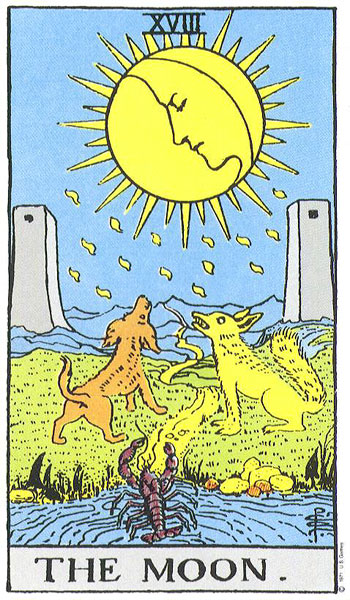
What the Card Shows
If you draw the Moon in a spread, the first useful move is simply to look. Most traditional Major Arcana decks picture a large, pale moon hanging between two towers, with a winding path leading away from the viewer toward distant hills. A body of water sits in the foreground, and small creatures are often visible near the path or emerging from the pool. The dominant impressions are cool light, soft edges, and partial visibility rather than sharp clarity.
Because the Moon belongs to the Major Arcana and is numbered 18, many readers treat it as a stage in a longer story of personal development rather than a single event. Treat that framing as a convention, not a rule. The point is to notice what is on the card and to ask what is intentionally missing. For example, the path on many versions of the Moon card disappears into shadow at the far edge. The towers stand on either side of the scene but no doors or windows are clearly lit. The animals shown are typically nocturnal and oriented toward the moon rather than each other. Each of these details can be observed, none of them tell you what will happen tomorrow.
When readers ask about the moon tarot card meaning, they often expect a tidy list of outcomes. A more honest starting point is a careful description. Write down what you can actually see on your specific card, including the colors, the placement of figures, and the proportions of light to dark. Keep that description separate from any symbolic guess. That separation is what makes later reflection useful, because you will know which statements come from the image and which come from the reader.
A note on deck variation: if you are working with a non-traditional deck, a beginner's deck, an art-deck, or a printed digital version, the imagery may differ from the classical Rider-Waite-Smith composition. Stick to what is in front of you. Do not assume every Moon card shows exactly the same features, and do not feel pressure to match your card to a description written for a different one.
Upright and Reversed: Two Reflection Lenses
Tarot readers treat direction as a soft signal, not a verdict. With the Moon upright, the editorial prompt points to ambiguity, imagination, and movement through a situation before all facts are available. Upright placement can be a useful mirror for moments when you genuinely do not yet have enough data, when a story keeps changing in your head, or when creativity is high but evidence is thin. The tone of the card in this position is a pause. Not a refusal to act, and not a command to act, but a request to slow down and label what you actually know.
Reversed, the Moon is often read in one of two ways, and honest readers hold both at once. The first is that confusion may be lifting. A foggy situation has begun to clarify, perhaps because new information has arrived, or because you have stopped adding imagined details. The second is that anxiety may be filling the gaps that direct verification would otherwise close. In other words, the reversals do not cancel each other out; they describe two different ways that uncertainty can resolve. One path requires evidence. The other requires restraint.
A practical way to handle this is to treat direction as a question rather than an answer. Upright: what is unclear, and what would it take to clarify it? Reversed: what is becoming clearer, or what is my nervous system filling in? Either way, the card is asking you to slow the pace of interpretation. Honesty about which way the uncertainty is moving will do more for you than any confident-sounding claim about what the universe is supposedly trying to say.
Because Tarot is not a prediction, neither upright nor reversed describes a future that is fixed. They describe a present condition and a likely emotional texture. Treat that text as a noticing tool, then go look at the rest of your life.
A Grounded, Low-Stakes Example
Consider someone who has just started a new freelance contract. The client sends a friendly first email, asks for a small revision, and then goes quiet for ten days. Our reader pulls the Moon upright, and their imagination begins generating stories. Some are hopeful: the client is busy with another project and trusts the reader to deliver. Others are anxious: the client is reworking the scope and planning to reduce the fee. Both stories fit the available facts. Neither is supported by them.
The grounded move is to treat the Moon as a prompt to ask which details are observable, which are inferred, and which are feared. Observable: an email, a small revision, ten days of silence. Inferred: the client may be busy. Feared: the client may be unhappy or planning to cancel. The card's job is to keep those categories separate long enough for the reader to send a polite follow-up email and to gather real evidence.
Notice what the example does not include. It does not predict whether the contract will continue. It does not claim to read the client's mind or motives. It does not produce a verdict on whether anxiety is justified. The example is intentionally low-stakes: even if the follow-up email reveals something difficult, the cost is mostly emotional, and the reader retains agency. That scale matters. The Moon's reflective power is highest when the consequences of being wrong are modest, so the reader can think clearly without pressure.
This is also why recording ambiguity is part of the practice, not a flaw in it. If you write, "the client has not replied in ten days and I feel uneasy," that sentence is useful whether the next email is a thank-you or a scope change. If instead you write, "the contract is doomed because of this card pull," you have lost the very uncertainty the Moon is asking you to hold.
A Reader's Verification Checklist
The most useful habit you can build around this card is a simple checklist for journaling. The card data offers three core questions: which part is observed, which part is inferred, and which part is feared. Expand those into a short form you can fill in after every reading that involves the Moon, whether the reading was for a personal question or a creative exercise.
Start with observation. Write one or two sentences describing only what is on the card and what is true in your situation right now, with no interpretation attached. If the email example is in front of you, that means recording that the email arrived, that a small revision was requested, and that ten days have passed. Observation should be boring. That boredom is the point.
Move to inference. Note the explanations you are considering, and label them as inferences. Being paid to wait, being forgotten, being tested, being trusted — each is a plausible story. They are not equal in likelihood, but they are also not yet testable. Once labeled as inferences, they become a list of working hypotheses rather than a single emotional conclusion.
Then move to fear. Name what you are afraid of, separately from what is happening. The distinction matters because fear often borrows the language of evidence. Saying, "I am afraid the project is being canceled," is different from saying, "the project is being canceled." The first is a feeling you can carry and still send a careful follow-up email. The second tends to produce reactive decisions.
Finally, jot down what disconfirming evidence would look like. If you fear cancellation, what would a friendly continuation look like? If you assume trust, what would a warning sign be? Treat ambivalent or ambiguous evidence with the same seriousness as an apparent match. A single friendly word does not prove trust. A single delayed email does not prove abandonment. Write the partial signals down so they can be updated later when more data comes in.
This kind of verification is the part of Tarot practice that survives contact with the rest of your life. It is also the part that keeps the Moon honest.
Where the Symbolism Ends
Tarot is a system of symbols, and symbols stop where evidence begins. The Moon does not know whether your friend's silence is meaningful. It does not know whether the job market will open or close. It does not know what your colleague said about you in a meeting you were not in. Treating the card as if it carried that information turns reflection into a kind of hallucination, where strong feelings and weak facts look identical from the inside.
If a question involves your health, safety, finances, legal status, or relationships with people who have their own complex inner lives, the right next step is to talk to a qualified human — a clinician, a lawyer, a financial planner, a trusted friend, an emergency contact line. The Moon can sit alongside that step, but it cannot replace it. This is true for several reasons. Tarot cards are not diagnostic tools. They do not measure anything in the world. They were designed in particular cultural contexts with particular assumptions, and modern decks remix those origins in ways that change the imagery and the associations. None of this disqualifies the practice, but it does set its boundary.
Two further limits are worth saying out loud. First, you will sometimes read the Moon for another person and feel strongly that you know what they are thinking. You do not. Treat that feeling as data about you, not about them. Second, readings can be biased by what you already want to hear. If you are rooting for one outcome, a vague card will usually feel like confirmation. That is why journaling and disconfirmation prompts matter.
Pairing This Card with Real Evidence
The Moon is most useful when it pairs with ordinary, mundane information. After a reading that surfaces ambiguity, make a short list of one or two practical questions you could answer with a phone call, an email, a document, or a short conversation. Choose the cheapest test that would change your mind.
Schedule when you will run that test, and write down what you expected to find beforehand. Set a date when you will re-read your notes. If new evidence arrives, update the observation. If new evidence does not arrive, write that down too. Silence is data.
Over time, this creates a record of how your mind works under uncertainty, separate from any single draw. You start to see which worries dissolve on contact and which keep returning. You also start to see when the card is naming a situation accurately and when your imagination is doing the heavy lifting. Both kinds of feedback are valuable, and both are easier to accept when they have been recorded rather than remembered.
A reflection practice built this way does not promise answers. It promises a clearer sense of which questions to ask next, and that is usually enough to move through the Moon's twilight without losing your footing.
Share this article