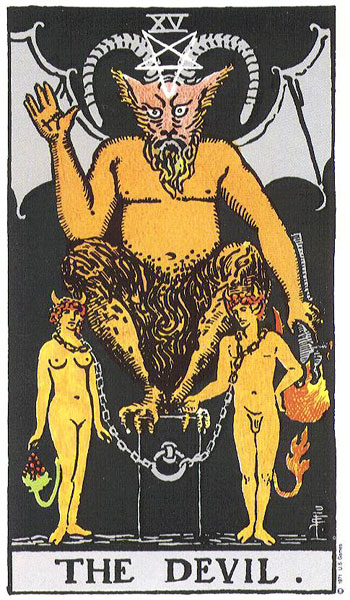
The Devil Tarot Card Meaning: Where to Begin
When readers search for the devil tarot card meaning, they usually want to know whether this card warns of something, signals a dark turn, or simply names an uncomfortable pattern. The grounded way to use this Major Arcana card is as a mirror, not an oracle. Tarot, used reflectively, is a structured prompt for self-examination. It does not predict outcomes, reveal hidden enemies, or describe the inner life of another person. Anyone holding this card after a draw can treat it as an invitation to pause and look closely at the part of their situation that feels stuck.
The Devil sits at number fifteen in the Major Arcana, the sequence of large archetypal patterns that runs through a full tarot deck. Position fifteen often carries themes of attachment, compulsion, and the moment when a bargain's price becomes visible. The card belongs to the reflective tone of pause rather than action. That tone is part of the meaning: the card is asking you to slow down, not to push through.
If you are reading for yourself, take a breath before interpreting. If you are reading for someone else in a casual setting, remember that you are offering a prompt, not a verdict. The Devil asks the reader to look at what feels unavoidable and ask whether the un-avoidability is real or simply habitual.
What the Imagery Actually Shows
The classic image associated with this card is widely recognizable: a large horned figure seated on a low pedestal, holding a raised implement, with two smaller human figures standing at the base. Around the human figures are chains that appear, on close look, to drape loosely rather than bind tightly. Above the seated figure, a five-pointed shape is shown with one point directed downward.
These details matter because they quietly contradict the most dramatic readings people bring to the card. The chains are not locked in place. The figures could, in principle, step away. The downward-pointing star suggests inversion, a turning over of priorities rather than an external force pressing down. None of this proves anything metaphysical. It simply shows that the imagery itself is built around choice hidden inside apparent necessity.
When you look at the card, try to describe only what you can see. Avoid loading the description with narrative. "There is a large figure, two smaller figures, loose chains, and an inverted star" is observation. "I am enslaved and the universe is warning me" is interpretation. The first is useful evidence. The second is a story you are telling yourself. The card works better when you keep those two layers separate.
Upright Reading: Attachment and the Cost of a Bargain
Upright, the Devil card points toward attachment, compulsion, or a bargain whose cost becomes clearer when examined directly. None of these words is dramatic on its own. Attachment is a normal feature of human life. Compulsion is a clinical word that may or may not apply to what you are feeling. A bargain is simply an exchange whose terms can be reviewed.
The upright reflection prompt from this card is: What feels unavoidable but may actually contain a choice, cost, or exit?
This is a question, not a diagnosis. To use it well, write down the situation that came up while you were looking at the card. Then answer three sub-questions:
1. What is the apparent cost of staying where you are? 2. What would the explicit cost of leaving look like, written in plain language? 3. Where did the original agreement to enter this arrangement happen, and was it actually a free choice?
The third question is often the most revealing. Many attachments feel predestined only because the moment of original consent has been forgotten. You may have agreed years ago, under different circumstances, and the agreement has been quietly renewed through inertia ever since.
Common upright situations include a habit that has grown into a constraint, a relationship pattern that repeats with minor variations, a job that started as a choice and now feels like a sentence, or a financial setup whose fees and friction were not examined carefully when it was first set up. None of these requires a tarot card to identify. The card simply asks you to do the looking.
Reversed Reading: A Loosening That Still Requires Accountability
Reversed, the card suggests that a binding pattern may be losing its hold, though accountability is still required. This is a careful statement, and it is worth reading slowly.
"A pattern may be losing its hold" does not mean the pattern is gone. It means the grip is weakening. You may notice more daylight between an urge and the action that follows it. You may feel less fused with the role you have been playing. You may find that an old compromise no longer seems worth its price. Any of these can show up in real life as a small but real change.
"Accountability is still required" is the part readers sometimes skip. A loosening is not a clean break. If you benefited from the pattern, or if other people were affected by it, the obligations created during its active phase do not vanish automatically. You may owe an honest conversation, a refund, a public correction, or simply the work of rebuilding a habit. Reversed does not mean you are off the hook. It means the hook is smaller and your hand is steadier.
A useful reversed prompt is: Where is a constraint loosening, and what concrete step can I take today that respects both the new flexibility and the old responsibility?
If you cannot point to a concrete step, the loosening may not yet be real. It may only be a wish. Wishing for change is not the same as change.
A Grounded Example: A Low-Stakes Look at a Recurring Choice
Consider a low-stakes example that almost anyone can recognize: a streaming subscription you keep paying for even though you no longer watch it. The cost is small in absolute terms. That smallness is exactly why it is a useful example.
You draw the Devil upright. The card prompts you to ask what feels unavoidable about this charge. You might answer, "I keep it because cancelling is annoying and I might want it next month." That is a real reason, but it is not the same as needing the subscription. It is the same as a small, automatic renewal that you have not bothered to inspect.
If you draw the card reversed, the prompt points you toward a pattern that may be loosening. Maybe you cancelled the subscription six months ago and felt a small but real sense of relief. That relief is data. The reversed card also asks you to honor any accountability that remains, such as closing the account fully or following through on the final billing cycle.
The point of this example is not that a tarot card diagnosed a recurring charge. The point is that the card offered a prompt, and the prompt gave you permission to look at something you had been ignoring. The actual work of deciding whether to cancel was yours, and it required ordinary tools: a settings screen, a confirmation email, and ten minutes of attention.
You can substitute almost any recurring low-cost situation: a group chat you do not enjoy, a default app on your phone, a Tuesday meeting that drifts from agenda to gossip, an old playlist that plays in the background of every work session. The Devil card does not single out dramatic entanglements. It quietly points to the small ones too.
How to Test Your Interpretation Against Real Evidence
A reflective tarot practice is only as useful as the evidence you gather around it. Once you have written an initial interpretation, the next step is to test it. Below are journal questions you can answer, ideally the same day as the reading.
- What concrete observation led to this interpretation? Write the observation in one sentence, without metaphor. - What is one piece of evidence that would contradict my interpretation? Be specific. If you cannot name one, you are probably telling a story rather than reading a situation. - What would a calm, skeptical friend say about this interpretation? Write that sentence down, even if you disagree with it. - Where is the ambiguity in what I am seeing? Name at least one alternative reading of the same situation. - What would I do in the next 48 hours if this interpretation were completely wrong? That answer is your baseline, the action you can take regardless.
Record ambiguity and disconfirming evidence as carefully as an apparent match. A reading that only confirms what you already suspected is not very informative. A reading that holds up under a genuine attempt to break it is more interesting, even if the conclusion is humbler than the original story.
Limits of This Reflection and When to Seek Outside Help
Tarot, used this way, is not a prediction. It does not forecast health outcomes, legal results, financial returns, or the intentions of another person. If you are facing a decision in any of those areas, the responsible next step is to consult a qualified professional who can work with verifiable information. A therapist, a doctor, a financial planner, a lawyer, or a crisis line is the appropriate resource when stakes are real. A reflective prompt from a deck of cards can sit alongside that work, but it cannot replace it.
This card, in particular, is sometimes used to dramatize relationships or to imply that one person has been hexed or trapped by another. That framing is not supported by the reflective meaning of the card. Attachment and compulsion are patterns you can name in yourself. If you suspect harm from another person, that is a question for someone trained to assess it, not for a card.
Use the Devil card as a pause button. Read the imagery without overloading it. Test your interpretation against evidence. Keep a record of what you saw and what you did next. Treat any dramatic certainty with suspicion. The card's strength is its plainness: it points to a pattern, asks you to look at it, and then lets you decide.
Share this article