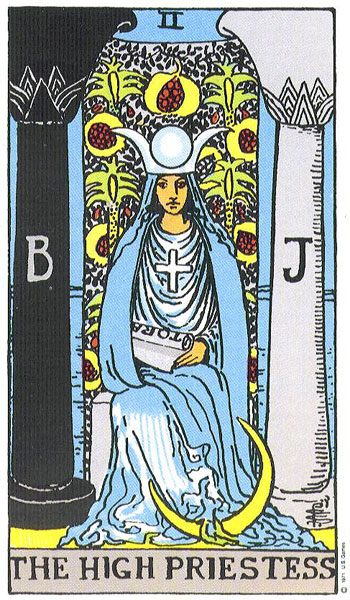
What the Card Shows: Observable Imagery
The High Priestess is the second card of the Major Arcana, marked with the number 2. In the most widely recognized version of the artwork, a seated figure in flowing robes sits between two pillars, one darker and one lighter. A veil hangs behind the figure, often patterned with pomegranates or fruit. At her feet rests a crescent moon, and across her lap is a scroll, partly hidden, partly visible. Behind the veil there is usually water, sometimes still, sometimes rippled.
Several of these features are worth pausing on, because they are doing quiet work in the picture rather than dramatic work.
The two pillars represent a threshold. One is dark, one is light, and the figure sits between them rather than choosing one. This is not a card of decisive action. It is a card of standing at the boundary.
The scroll is half-visible. Knowledge is present but not fully disclosed. Whatever the scroll says, the viewer cannot read all of it from outside.
The veil and the water suggest hidden or slow-moving information. You can see there is something behind, but the surface is not transparent.
The crescent moon points to cycles and to a softer kind of light. The figure is not lit from outside by something dramatic. The light is internal and gentle.
This is not a portrait of a historical person. It is symbolic artwork, and different decks use different visual languages. What stays consistent across most decks is the posture: seated, still, between two contrasting elements, with a scroll or book that is not being read aloud.
The reason imagery matters in a guide like this is that the visual cues point to the same themes the upright and reversed meanings emphasize: stillness, threshold, withheld information. When you read this card, you can let the picture itself be a reminder of what the writing tries to describe.
Upright Meaning: Pause, Observation, and Incomplete Information
When the High Priestess appears upright in a reading, the meaning is not a prediction. It is a prompt. For readers looking up the high priestess tarot card meaning, the upright reading points toward quiet observation, incomplete information, and knowledge that tends to emerge through patience rather than force.
Quiet observation is the first idea. This is the card's central suggestion. Many problems feel urgent in the moment because we are staring directly at them. The upright High Priestess asks whether the situation would look different if you stepped back for a day or two.
Incomplete information is the second idea. The High Priestess does not promise that you will have full clarity soon. It suggests that you do not yet have it, and that pushing harder for an answer is unlikely to bring one. The information is somewhere in the room, but it has not surfaced.
Knowledge through patience is the third idea. The intuition keyword on this card is not the same as a sudden flash. It is more like noticing something that was always there once you slowed down enough to see it.
Practical uses for an upright High Priestess include: deciding whether to make a fast decision or wait; paying attention to what you have been dismissing; listening more than speaking in a meeting; checking whether a feeling you have about someone has any small piece of evidence behind it, or whether it is pure projection.
The upright card is also a good moment to write down what you actually know, separate from what you are guessing. That act of separating known from guessed is itself a form of the patience this card asks for.
Reversed Meaning: When Silence May Be Hiding Avoidance
The reversed High Priestess does not flip the upright meaning into its opposite. It sharpens it. The same themes of stillness and inner knowing remain, but with a question attached: is the silence protecting genuine reflection, or is it covering avoidance? And: is the intuition you are feeling something that would hold up against evidence, or something that would not?
The reversed card can show up at moments when the reader has been telling themselves they are being patient, when in fact they have been putting off a decision they already know they need to make. Silence can be a way of not saying the difficult thing. Withdrawal can be a way of avoiding a hard conversation.
It can also show up when an intuition keeps recurring and is being dismissed. In that case, the reversed card is asking whether the dismissal is fair. Is there a small piece of evidence behind the feeling? Or is the feeling only being repeated because it is familiar?
Both readings are possible. The card itself does not choose between them. The reader does, by looking at what is actually happening in their life.
A useful test: if you have been quiet for a week and nothing has changed, the silence may be avoidance. If you have been quiet for a week and small useful pieces of information have surfaced, the silence may be working.
The reversed High Priestess also invites you to test intuition against evidence. A feeling can be present and still be wrong. A feeling can be present and still be right. The card asks you to notice which, and to record both possibilities in your journal without collapsing them into one conclusion too early.
How to Read This Card Without Overclaiming
Tarot is not a prediction. No card in the deck tells you what will happen tomorrow, what someone else is thinking, or what decision you should make. The High Priestess is no exception.
When you draw this card, you can use it as a prompt to reflect, not as a source of facts. The reflection prompt that ships with this card is a useful starting point: what do you notice when you stop trying to force an immediate answer?
This is not a question about the future. It is a question about your present state. It can be asked in any kind of decision, big or small, because it is about how you are relating to the decision rather than what the decision is.
A common overclaim is to treat a calm moment as a sign that the universe is telling you to wait. Sometimes a calm moment is just a calm moment. The card's prompt is a question, not an instruction.
A second common overclaim is to treat an uncomfortable feeling as proof that you should not act. The High Priestess asks you to slow down, but slowing down is not the same as never moving. It is a pause, not a stop sign.
A third overclaim is to read the card as confirmation of a conclusion you already held. Tarot cards are easy to read as agreement. They are harder to read as a check on a conclusion. The honest reader records both apparent matches and disconfirming evidence in their journal, and treats both with the same seriousness.
When you record a reading involving this card, it helps to write down what you observed, what you felt, and what you actually did afterwards. That record makes it possible to look back later and see whether the card's prompt helped you make a better decision, or whether it was just a pleasant frame for whatever you were already going to do.
A Grounded Example: A Decision About a Side Project
Imagine you have been considering whether to launch a small side project for several months. You have read about it, talked to a few friends, and sketched some ideas. You keep telling yourself you are not ready.
You draw the High Priestess.
One way to read this: the upright meaning fits. You do not yet have enough information. You have been pushing for an answer and the answer has not come. The card's prompt is to stop trying to force a launch date and to notice what surfaces when you stop.
Another way to read this: the reversed meaning fits. You have been telling yourself you are being patient, but you have not actually been doing research in the past two months. The silence has been avoidance, not reflection. The project is going nowhere because you are not doing anything to move it, not because you are gathering signal.
Both readings are possible from the same card. To test them, you can ask a few simple questions in a journal: in the past two weeks, what new information have I gathered? Have I spoken with anyone who has actually done this? Have I written down what specifically I am unsure about? If the answers are all empty, the silence is avoidance. If the answers are full of small observations, the silence is working.
Notice that the card does not tell you to launch or not to launch. It tells you to look at the quality of your waiting.
The same example can be reused for larger decisions: a job offer you cannot quite accept, a relationship conversation you keep postponing, a move you keep researching without committing to. In each case, the High Priestess asks you to look at whether your pause is producing anything or simply stalling. The cards support that question; they do not answer it for you.
Reflection Questions to Test in a Journal
These questions are designed to be written down and revisited. They are not a quiz. They are an invitation to look honestly at the situation you are in. Use them when you have drawn the High Priestess, upright or reversed, or when you simply want to slow down before deciding something.
1. What do I notice when I stop trying to force an immediate answer to this? Write the first three things that come up, without judging them.
2. What information is missing, and is there a realistic step I can take in the next week that might bring some of it to light?
3. Have I been quiet because I am gathering signal, or because I am avoiding a known next step?
4. What is the intuition here, and what small piece of evidence would either support or weaken it?
5. If a friend described my situation to me, would I describe their waiting as patient or as stuck?
6. What is one thing I could write down tonight that I would not have been able to write down a month ago? If I cannot think of one, what does that tell me about the quality of my pause?
7. What would I need to see to change my mind? Naming this in advance protects against both rushing and indefinite postponement.
8. Where might I be projecting onto this card rather than reading it? What was on my mind before I drew it?
The questions are deliberately evidence-aware. They are designed to work whether the card turned out to match your situation or not. If you fill them in and find that the reading was off, that is useful information. A reader who records both matches and disconfirming evidence is a reader whose journal will become more reliable over time.
Limits of This Guide and When to Use Real Evidence
A reflection guide is not a substitute for qualified help. If a question on your mind involves medical symptoms, legal exposure, financial risk, personal safety, or a crisis of any kind, the appropriate next step is a conversation with a licensed professional, not a Tarot card.
This is true for every card in the deck, including the High Priestess. The card's theme of patience and inner observation is not a treatment plan, a legal opinion, or a financial forecast.
Even for low-stakes decisions, it is worth recording what you actually know and what you are inferring. When you write a reading in your journal, note what was obvious before you drew the card, what was less obvious, and what was simply projected onto the card from what was already on your mind. Apparent matches and disconfirming evidence both deserve space in the record. Treating them with equal care is what makes a reading practice honest rather than wishful.
Over time, this kind of careful record is more useful than any single draw. It lets you see what patterns show up in your life when this card appears, and what patterns do not. That kind of self-knowledge, tested against real evidence and recorded without flattering yourself, is what the High Priestess, drawn quietly and used carefully, is actually pointing toward.
Share this article