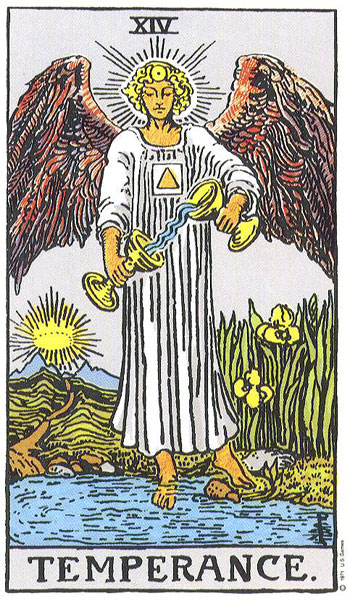
What the Card Shows: Observable Imagery
Before exploring the temperance tarot card meaning, it helps to look at what is actually drawn on the card. Tarot decks vary, but the most widely circulated image of Temperance (Major Arcana, number 14) contains a small set of recurring visual elements that you can observe directly. The image file for this card is referenced at `/tools/tarot/cards/m14.jpg`.
A winged being, often described as an angel, stands with one foot on land and one in a stream, suggesting contact with more than one environment at the same time. The figure pours liquid between two cups. The pour is usually drawn as a continuous arc rather than a splash, which is worth noticing because it implies controlled transfer rather than loss. One cup tilts to receive while the other tilts to release; nothing is dropped.
Behind the figure there is typically a landscape with a path winding toward hills or mountains. There is often a sun or solar disc near the top of the card, and the colours tend toward warm yellows and softer blues. The card is labelled XIV in most traditional decks.
None of these details are proof of anything. They are simply things to look at. Temperance is not a prediction; it is a piece of art used as a prompt. The first interpretive choice is yours: what stands out when you look, and what does that detail remind you of in your current situation?
The Upright Meaning: Integration, Calibration, Moderation
In an upright position, Temperance points toward integration, calibration, and patient adjustment between elements that do not combine automatically. The card's keywords are integration, calibration, and moderation, and the editorial reflection question assigned to it is: "What small adjustment would make the whole system easier to sustain?"
That phrasing is deliberate. "Whole system" treats the situation as a connected set of moving parts. "Small adjustment" discourages dramatic redesigns. "Easier to sustain" points to change that holds up over weeks rather than days.
In practical terms, an upright Temperance can prompt reflection in areas such as:
- Combining two roles, identities, or commitments that feel at odds, such as work and care responsibilities, without forcing one to absorb the other. - Blending skills from different areas of life into something workable, instead of treating them as competing tracks. - Pacing a long project so that early enthusiasm does not burn out the middle. - Adjusting a routine in tiny increments, such as sleep, movement, study, or contact with others, until the week feels livable.
The keyword moderation does not mean "as little as possible." It means "enough." It means no single element is so loud that it drowns out the others.
Reflection prompts for the upright position:
1. Name two elements of your week that do not currently combine well. What is the smallest change to one of them that would let the other breathe? 2. Where in your life are you overcorrecting because of one bad day? What would a steady middle setting look like? 3. What would you still be doing four weeks from now if you started today at a sustainable pace?
These are not prescriptions. They are prompts to help you generate your own observations and test them against what actually happens.
The Reversed Meaning: Proportion, Pacing, and Extremes
Reversed, Temperance shifts focus. The card's reversed meaning describes a process that may be out of proportion, rushed, or swinging between extremes. The same image is on the table, but the cup that pours and the cup that receives no longer feel matched.
Reversed Temperance is often associated with:
- All-or-nothing cycles, such as strict routines that collapse into complete breaks, or quiet stretches that suddenly become overstimulation. - Speed without calibration, where changes are made so quickly that they cannot be tested. - Imbalance between effort and recovery, giving and receiving, planning and doing, speaking and listening. - Mixing too many elements at once, where the blend becomes muddy rather than integrated.
The reversal is not a verdict. It is a flag. It asks you to look for the place where your system is no longer sustainable and to slow down before adjusting, rather than after something has already broken.
Reflection prompts for the reversed position:
1. Where in the past week did you swing from one extreme to another, and what triggered the swing? 2. Which part of your routine is over-stretched right now, and what is the first sign that it is failing? 3. If you kept going at the current pace for another two weeks, what would break first?
Again, these prompts only work if you answer them with real evidence from your own week, not with what you wish were true.
A Grounded Example: Mixing Work, Study, and Rest
Here is a low-stakes, realistic example. Imagine someone working a full-time job who has started an evening course. The upright Temperance prompt invites a small adjustment: keep the existing study schedule, but move one hour of reading from a late evening slot to a lunch break on Tuesdays and Thursdays. Sleep is protected, study hours are preserved, and the change is small enough to test.
Journal entries over two weeks might record:
- Energy on a 1–5 scale each evening. - Hours slept, recorded honestly rather than estimated. - Whether the Tuesday lunch slot actually felt usable or got eaten by work tasks.
If energy drops, the example provides a falsifiable signal. If the lunch slot consistently disappears into meetings, the prompt was wrong for the situation, and another small adjustment can be tried. The point is not to prove the card right. The point is to use it as a structured way to ask, "What would make this system easier to sustain?"
Now consider the same situation under reversed Temperance. Instead of a small change, the person decides to study every evening until midnight. By day ten, sleep has dropped from seven hours to under five. By day fourteen, a project at work suffers. A reversed Temperance reading would not have predicted this; it would simply have flagged the risk of swinging to an extreme. The actual evidence comes from the journal, not the card.
The example is intentionally ordinary. Reflection cards are most useful when paired with situations where you can check the outcome, not when applied to life-defining decisions you cannot control.
Reflection Prompts You Can Test in a Journal
A useful way to work with any tarot card is to treat the upright and reversed meanings as hypotheses, not conclusions. You can put the temperance tarot card meaning into practice by writing short notes against a small set of questions, then returning to them over time.
Try the following prompts over the course of a week, picking two or three at most so that journaling stays short enough to repeat:
1. What two parts of my week do I want to blend more skillfully, and what is one small change I can test? 2. What evidence, from my own behaviour this week, suggests that the change worked, was neutral, or made things worse? 3. Where am I currently swinging between extremes, and what would a steady middle setting look like? 4. What is the first concrete signal that a routine is no longer sustainable for me, and how will I notice it? 5. If a friend described my week, what word would they use to describe the pace: rushed, balanced, stalled, or scattered? 6. What is one element I have been treating as all-or-nothing that would benefit from gradual adjustment instead?
You do not need to answer all of these in one sitting. Pick one, write a short paragraph, and revisit it in seven days. The value of journaling is not the cleverness of the answer; it is the chance to compare what you predicted with what actually happened, and to update your working model accordingly.
Recording Ambiguity and Disconfirming Evidence
Tarot reflection works best when ambiguous readings and apparent misses are recorded as carefully as clean matches. This is a habit, not a rule, and it protects you from two common errors: confirming only what already feels true, and discarding the card entirely the first time it feels off.
A few practical habits help:
- Write down your interpretation before you check it against the day. The first read is often the most honest because it has not yet been smoothed by hindsight. - Note at least one possible meaning that does not fit. This keeps you from reading only the cards that flatter you. - Distinguish a near-miss from a clean match. "I was thinking about pacing and then felt rushed at work" is weaker evidence than "I was thinking about pacing and three specific events this week confirmed it." - Record what would change your mind. If nothing could, your belief is not a reflection; it is a fixation. - Track reversals of fortune honestly. A week that proved the opposite of what the card suggested is information, not failure.
These habits apply to every card, including Temperance. A session where you record "this card did not seem to apply, and here is why" is as useful as one where everything lines up. Over time, your journal becomes a record of which prompts helped you see clearly and which ones did not.
Tarot as Reflection, Not Prediction
It is worth saying clearly: Tarot is not a prediction. The cards do not know the future, do not diagnose medical conditions, do not give legal advice, and do not reveal what another person is thinking. If a reading points toward a decision about health, money, safety, or a relationship that involves someone else's wellbeing, use real evidence and qualified help. A doctor, a licensed financial professional, an attorney, or a crisis line is a better source than any deck.
What Temperance, like the other Major Arcana cards, can do is offer a structured prompt. It invites you to look at proportion, calibration, and patience, and to ask what small adjustment would make the whole system easier to sustain. Whether that prompt fits your week is something only your journal, your reflections, and your real-world evidence can tell you. Treating the card as a starting question rather than an answer keeps reflection honest, and keeps reflection separate from the decisions that deserve professional input.
Share this article