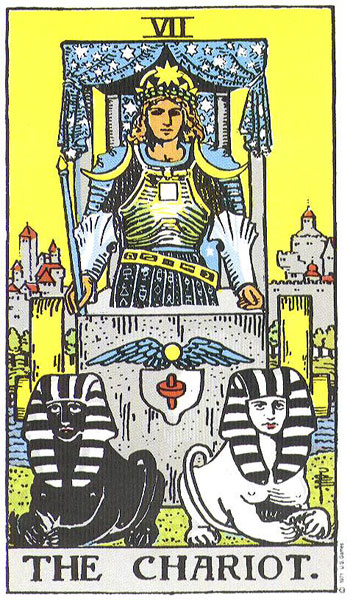
What the Card Shows
Before assigning any meaning to The Chariot, it can help to slow down and simply describe what is in front of you. Tarot decks vary in style, so no two versions of The Chariot look identical. Even so, a few visual cues show up across most traditional illustrations, and those cues are useful anchors for the rest of any reflection.
A central figure stands or sits inside a vehicle, often a chariot or wagon, pulled by two figures or two animals that face opposite directions. In many decks these are sphinxes, horses, or black and white creatures. The driver usually holds a wand, a staff, or reins. Behind or around the figure you may see stars, a canopy, a city, or a flowing banner. The number seven is often written on the card, because The Chariot is the seventh card of the Major Arcana.
Without claiming any hidden symbolism, here is what is plainly visible: there is a person, a vehicle, and two pulling forces that are not moving in the same direction. The driver is the only thing holding them together. A canopy or stars above suggest something larger is being looked toward, but the canopy does not steer. The driver does.
That image, on its own, is the cleanest summary of what the **the chariot tarot card meaning** tends to get attached to: a moment where competing pulls need a steady hand, and where progress depends on whether the driver's attention is on the road or on the horses.
Keeping the imagery concrete is a small but important habit. It stops the reflection from drifting into vague language like "success is coming" or "you will triumph." A chariot drawn by two opposing animals, with a single person trying to steer them, is not a picture of effortless victory. It is a picture of work.
The Chariot Tarot Card Meaning: Upright in Reflection
The upright position is usually described in guidebooks as directed momentum, willpower, and the discipline to keep moving. The supplied description for this card is in the same family: "directed momentum, coordination, and the discipline required to move competing forces together."
That phrasing is worth sitting with. "Directed" is doing real work in that sentence. It implies that energy alone is not the point. A car with the engine running but no one turning the wheel still goes somewhere, and usually not the place the driver wants. Upright Chariot reflections, then, tend to focus less on how much effort a reader is putting in and more on where that effort is pointed.
Three small reflection prompts fit this card well without overreaching:
- Where am I currently aiming, and can I state that aim in one sentence? - Which two "forces" in my week are pulling hardest, and are they aligned or opposed? - What small, repeatable action could I do today that moves me in the chosen direction?
A useful way to think of the upright Chariot is as a planning prompt, not an outcome promise. It does not say that plans will succeed. It says that plans are visible, that competing pressures are visible, and that the reader is being asked to pay attention to the steering.
For readers who already keep a planner, this card can be a useful cue to write down a single goal for the next two weeks and to check, at the end of each day, whether what was actually done moved toward it. That kind of check is not mystical. It is just clearer than guessing.
The Reversed Card as a Reflection Prompt
The reversed position is not automatically a warning or a punishment. It is a mirror that asks the same question from the opposite side. The supplied description puts it this way: "Speed may be outrunning direction, or competing priorities may be pulling against one another."
That is a calmer way to frame reversal than "failure" or "blocked energy." It treats the card as a diagnostic rather than a verdict. The two situations it describes are slightly different, and noticing which one fits is more useful than a generic worry.
If speed is outrunning direction, the reader is probably doing plenty. Calendars are full, tasks are being cleared, and yet the feeling of progress is flat or anxious. That is a familiar feeling, and it has ordinary causes: unclear priorities, lack of a measurable target, or a habit of collecting tasks instead of finishing meaningful ones.
If competing priorities are pulling against each other, the picture is different. Two real demands, each with merit, are tugging in opposite directions. A job that requires travel and a family situation that needs presence at home. A project that needs long quiet hours and a schedule that is full of meetings. Neither side is wrong. The friction is the point.
A few prompts for the reversed Chariot:
- What did I commit to this week, and which of those commitments did I quietly drop or postpone? - If two areas of my life are pulling against each other, what would it look like to reduce one of them for a defined period, instead of trying to carry both at full strength? - Where am I mistaking motion for progress?
A reasonable rule for reversed cards is to treat them the same way you would treat a friend's calm observation that you look tired. The point is not to be alarmed. The point is to look more carefully at what is already visible.
A Low-Stakes Example
Consider a reader named Jordan, who is using a daily draw of one card as a journaling prompt rather than as a prediction. Jordan pulls The Chariot upright on a Monday.
Jordan's week looks like this. Work has a deadline on Thursday for a written report. The report is half-written. Jordan has also promised to help a relative move on Saturday, and the gym routine is supposed to happen three times. None of these are emergencies. They are all real.
Reading The Chariot as a pure prediction, Jordan might expect a triumphant week. Reading it as a reflection prompt, Jordan notices the two animals pulling in different directions: work on one side, family and self-care on the other. The driver is Jordan's attention.
Instead of pushing harder on all three, Jordan picks the one outcome that most matters this week: finishing a draft of the report. The move help becomes a defined two-hour window on Saturday morning. The gym routine drops to one session, scheduled, not aspirational. Jordan writes these choices down.
By Friday, the draft is in. The move happened. The gym session happened once. None of this is dramatic. None of it required the card to be "right." It required Jordan to use the card as a prompt to align three forces that were pulling apart.
Now consider the reversed version of the same week. Jordan pulls The Chariot reversed on Monday. The work deadline is the same. The report is half-written, but Jordan also accepted two new tasks from a colleague "just to be helpful," and the gym routine is now four sessions in the plan, not three. Speed is outrunning direction. The reflection prompt is to look at what Jordan has actually committed to, and to remove at least one thing. Jordan cancels one gym session and asks the colleague to take the smaller task back. The week feels less full and a little less impressive, which is often the actual sign of a real correction.
In both cases, the card was a question, not an answer.
Testing an Interpretation Against Real Evidence
Because readers sometimes worry that they are "making the card fit," it helps to have a small set of questions that can be checked against a journal rather than against feelings.
A simple format is to write three things after each draw:
1. What did I notice in the image? 2. What is one specific situation in my life that this card could describe? 3. What would I have to see by the end of the day, the week, or the month to know that the card "fit" or "didn't fit"?
That third line is the most important one. It turns the reading into a testable note rather than a vibe. If the criterion is vague, like "I will feel more aligned," the reading is hard to evaluate. If the criterion is concrete, like "I will have sent the draft to a reviewer," it is easy.
It also helps to record what does not fit. Tarot guides sometimes quietly ignore reversals, awkward spreads, and cards that contradict each other. A reader can do better by writing down both matches and mismatches. If The Chariot upright appears next to a card that suggests waiting and stillness, that tension is information. It is not a sign that one card "won." It is a sign that two competing descriptions are sitting next to each other, and the reader's job is to notice that and write about it.
A short list of disconfirming evidence to look for is useful:
- The card suggested alignment, but the week was dominated by a single urgent demand that overrode everything else. - The reversed card suggested competing priorities, but the week turned out to be unusually calm and structured. - The image focused on a driver, but the reader's actual situation had no real decision to make, only one clear obligation.
Recording these is not a way to be cynical about the practice. It is a way to be honest about what the cards are doing in a reader's life. Sometimes they offer a useful prompt. Sometimes they offer a prompt that did not match the day. Both outcomes deserve the same careful note in a journal.
Limits of This Kind of Reflection
It is worth being clear about what this guide is and what it is not. Tarot cards, used as reflective prompts, can help a reader slow down, name a pattern, and decide on a next step. That is a real benefit, and it is the benefit this guide is built around.
This guide is not a system for predicting what will happen. No card, spread, or reader can reliably tell a person what another person will do, what the future holds, or what a hidden cause is producing a current symptom. Claims of that kind should be treated with caution, regardless of the deck used. Tarot is not a prediction, and treating it as one sets the practice up to fail in obvious ways.
For decisions involving health, mental health, legal matters, finances, or safety, the right sources are qualified professionals and direct evidence: a doctor, a therapist, a lawyer, a financial advisor, or, in a crisis, an emergency contact line. A tarot reflection can sit alongside those sources as a way of noticing your own state of mind. It should not replace them, and it should not be used as evidence that a risky choice is safe.
A few practical limits are worth keeping in mind:
- The meaning of a card is shaped by the deck, the reader, and the question. There is no single correct reading. - Reversed cards are a stylistic choice in some decks and a deliberate flip in others. Treat the choice as part of the practice, not as a hidden message. - A reading that produces a calm, useful question is more valuable than a reading that produces a dramatic claim. - If a card reliably "predicts" outcomes that already felt inevitable, that is a sign to record the prediction before knowing the result, not after.
The Chariot, in this sense, is a card about attention. The driver in the image is not doing anything supernatural. The driver is paying attention to the road and to the horses at the same time. That is a difficult task, and it is the same task any reader faces when they sit down with a card and ask, honestly, what is pulling at me right now, and which way am I going to steer.
Share this article