How to Read The Lovers Without Overreading
Tarot is not a prediction. A single card drawn today cannot tell you what someone else will say next week, whether a job offer is genuine, or how a relationship will end. What a card can do is offer a structured prompt for reflection — a way to slow down and notice what is already present in your situation but may be slipping past attention.
This guide treats the lovers tarot card meaning as a tool for reflection rather than a forecast. The same care you would apply to interpreting a friend's vague text message applies here: hold the message loosely, ask what evidence would support it, and write down what evidence would contradict it. Recording disconfirming evidence is just as important as recording an apparent match, because most decisions look obvious only in hindsight and only after you have forgotten the alternative readings you considered earlier.
Throughout this article, you will see prompts for both the upright and reversed orientations of the card. Treat these as separate lenses, not as one being "good" and the other "bad." A reversed card is not a warning; it is a different angle on the same set of themes. Neither orientation is a verdict on the people or situations you are weighing.
What You Can Observe in the Imagery
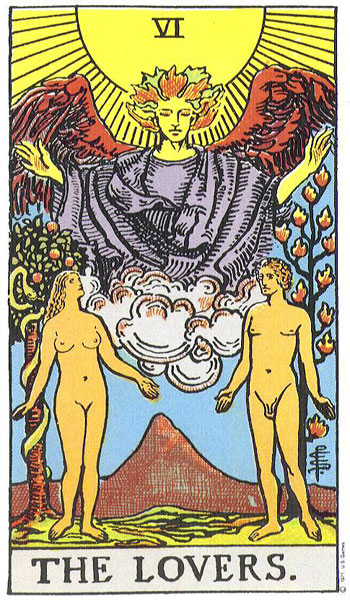
Before applying any interpretation, it helps to slow down and look at the card itself. The Lovers is the sixth card of the Major Arcana, and in its most widely reproduced form it shows three vertical elements: a winged figure above, two human figures standing side by side in the center, and two trees — usually understood as one on each side of the figures. A serpent is sometimes visible near one of the trees. The number VI typically appears at the top of the card.
These visual elements are observable facts. Whether you read the winged figure as an angel, a muse, or simply a symbol of an external presence above the two figures is a matter of framing, not evidence. The same goes for the trees and the serpent: they are present, but their meaning is supplied by the reader's own associations, not by the card itself.
For reflection purposes, three visual details are worth noticing:
1. **Two figures, not one.** The card does not depict a solitary decision. Whatever you are weighing, another value, person, or commitment is standing next to it. 2. **A presence above.** Whatever rises above the figures is not inside their heads. It suggests an external standard or ideal they are holding themselves against, even if neither of them has named it aloud. 3. **Two trees, often in balance.** The visual symmetry implies a contrast — two options, two commitments, two versions of a future — that the figures are facing together rather than one at a time.
When you draw the card, try describing the image in your own words before reading anything about it. The description you write down is closer to your own situation than any generic interpretation, because it is filtered through what you noticed and what you skipped.
Upright Meaning: A Practical Reflection
Upright, The Lovers points to a moment where what you value and what you choose line up, and that alignment becomes visible — often through a relationship or a commitment. The upright card is not telling you the alignment is perfect. It is pointing to a place where the connection between values and choice is worth examining in detail.
A practical way to read this is to ask: what value do you want this decision to make visible? If the decision is to move in with someone, the value might be companionship. If it is to take a new job, the value might be craft, security, or learning. If it is to end a habit, the value might be honesty or rest. The card, drawn upright, is a prompt to name the value out loud so that the choice you are about to make can be checked against it before, not after, you commit.
Some reflection prompts for the upright orientation:
- What value do I want this decision to make visible to others, and to myself? - Where in my life right now am I already acting in line with what I claim to value? - Is there a commitment I have been postponing because naming it would require change? - What would a clear-headed friend notice about my current pattern of choices?
These prompts are not predictions of the outcome. They are questions that, if answered honestly, give you a clearer picture than the card alone.
Reversed Meaning: Where the Agreement Slips
Reversed, The Lovers suggests competing values, an unclear agreement, or a choice made to avoid discomfort rather than to express conviction. Note the wording carefully: it does not say "wrong choice" or "bad relationship." It says the agreement is unclear, or that the choice is being shaped by the desire to dodge a difficult conversation.
The reversed card is especially useful when you suspect you are talking yourself into something. Common signs include the following:
- You are saying "yes" to avoid an argument you do not want to have. - You have not actually asked the other person what they want; you are assuming. - The reasons you give for the decision would not survive being written down. - Two of your stated values are pulling in opposite directions, and you are pretending they are not.
Some reflection prompts for the reversed orientation:
- Which discomfort am I trying to avoid by making this choice quickly? - Where is the agreement between me and the other person actually unclear, and what would it take to clarify it? - What value am I leaving out of the conversation because it is inconvenient? - If I were writing a private journal entry about this in a year, what would I want to have written today?
The reversed Lovers is not a verdict. It is a prompt to slow down and to put the agreement in writing, even if the writing is just for yourself.
A Grounded, Low-Stakes Example
Suppose you have been offered a small freelance project. The pay is fair, the work fits your skills, and the client is pleasant. You draw The Lovers reversed and feel a jolt of anxiety.
A reflective reading, not a predictive one, might go like this. You notice the reversed card and ask what discomfort you are trying to avoid. On closer look, you realize the project would crowd out three evenings a week that you have been quietly protecting for a long walk. Walking is not a value you usually name, but it is one that keeps you calm and gives you time to think. The reversed card is pointing to a value you have not put on the table: your own unstructured time.
You write this down. You also write down the disconfirming evidence: the project is interesting, the client is reliable, the pay would let you save for something you have been planning. The reversed card does not mean "do not take the job." It means "name the value you are trading away before you trade it." If, after naming it, you still want the project, you take it with open eyes. If not, you decline without resentment.
Notice what the card did not do. It did not predict the client's behavior. It did not tell you whether the project would lead to more work. It did not reveal anything about the client's private thoughts. It offered a single image and a single theme — values, choice, agreement — and invited you to apply it to your own situation.
Journal Questions to Test the Interpretation
A reflection is only as useful as the evidence you gather for and against it. Before you accept any reading, take ten minutes to write down answers to the following. Keep them dated so you can revisit them later.
1. What is the specific decision or situation I am bringing to this card? 2. What value do I want this decision to make visible, in one sentence? 3. What evidence would support that this value is genuinely at stake? List at least two concrete examples. 4. What evidence would contradict the interpretation? List at least two. 5. If a respected friend read the same card in my place, what would they likely say, and what would they likely leave out? 6. What would I need to learn or confirm from another source before acting on this reflection? 7. Six months from now, what would I want to have written down today?
The seventh question is the most important one. It forces you to write for a future version of yourself who will not remember what you were feeling. If your answers read clearly to that future reader, the reflection has done its work. If they read like a justification, you may have skipped a step.
It is also worth recording what the card did not seem to fit. A mismatch is information, not a failure. If the upright Lovers' themes of alignment feel forced in your situation, write that down. If the reversed card's emphasis on unclear agreement does not match anything in your decision, write that down too. Ambiguity is part of honest reflection, and pretending it is not there makes the reading weaker, not stronger.
Limits of Interpretation and When to Use Real Evidence
It is worth stating directly: Tarot is not a prediction. It cannot diagnose a medical condition, settle a legal dispute, predict market movements, or tell you whether another person is trustworthy. Those questions deserve qualified professionals and real evidence.
Within its narrow scope, the lovers tarot card meaning offers a structure for thinking about alignment between values and choice. Used well, it can slow you down enough to notice what you were about to skip. Used poorly, it becomes a way to dress up a decision you had already made before you ever sat down with the cards.
A simple test: if your reading of the card would not change if the card were different, you are not really reading the card — you are reading yourself. That is not a problem, as long as you are honest about which one you are doing, and as long as you remember that the card itself is a prompt, not a source of authority.
For decisions involving health, law, finances, safety, or crisis, please consult a qualified professional. The card can be a prompt to prepare for that conversation, not a substitute for it. Real life decisions deserve real evidence, gathered carefully and weighed against your own stated values — the same values this card asks you to name out loud.
Share this article