How to Read This Guide
If you have searched for the **wheel of fortune tarot card meaning**, you may want a quick interpretation, a feel for the imagery, and some way to tell whether a reading is genuinely useful or simply telling you what you already wanted to hear. This guide is designed for that kind of reader.
A few things to keep in mind from the start.
- **Tarot is not a prediction.** Cards do not know your future, your health outcome, or another person's intentions. They are prompts for reflection, drawn from a symbolic system that has been used for centuries. - **A card's meaning is shaped by what you bring to it.** Two people can draw the same card and notice different things. That is not a failure of the deck; it is a feature of using symbols. - **Reflection should be tested against evidence.** Real decisions, especially those involving money, health, relationships, or safety, deserve real data and qualified advice. A reading is a place to think, not a place to stop thinking.
The Wheel of Fortune is Major Arcana card number 10. It sits among the "greater" cards, which usually describe themes that touch many parts of a life rather than a single, narrow event. Themes attached to it include **change**, **cycle**, and **adaptation**. The tone of this card is mixed: it carries both an opening and a closing, a rise and a turn.
What follows is a calm walk through what you can actually see on the card, what the upright and reversed orientations tend to invite you to think about, a small realistic example, and a short set of questions you can copy into a journal if you want to test a reading against your lived experience.
Observable Imagery of the Wheel of Fortune
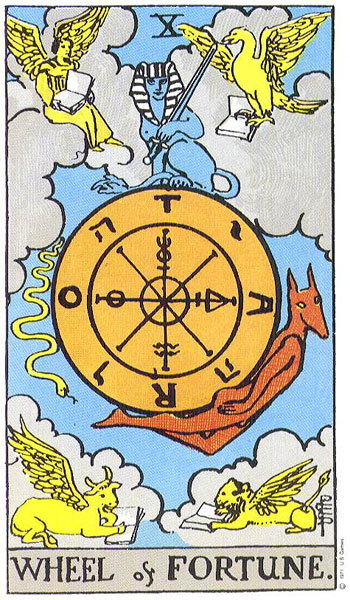
Before reading any meaning into a card, it helps to slow down and describe what you see. For the Wheel of Fortune, several elements appear across most traditional decks, including the well-known imagery that many modern decks draw from. Look at your specific card and note what is actually present; not every deck shows the same figures, and what you notice first is part of the reading.
Common elements you may observe include:
- **A large wheel at the center**, often drawn with spokes, suggesting motion, rotation, and the way conditions move from one state to another. - **Figures positioned around the wheel.** Many decks show a creature resting on top, another descending on one side, and a third ascending on the other. You can read these as three different relationships to the turning motion: holding steady, falling, and rising. - **Four winged forms in the corners**, often an eagle, a lion, an ox, and a human figure. They can be treated as four viewpoints watching the same wheel turn. - **A sky or cloud-filled background**, sometimes with small marks along the rim of the wheel. - **The number 10**, marking its place in the Major Arcana sequence.
The key observable fact is that the wheel is **already turning** in the image. Nothing in the picture suggests the wheel is waiting for permission. This matters when you sit with the card, because it nudges you to ask what is already in motion rather than what you wish were in motion.
A short exercise: take sixty seconds and write down five things you can literally see on the card. Color, posture, direction of gaze, what is in the background, what is at the center. Your list may differ from another reader's, and that difference is useful information rather than a wrong answer.
Wheel of Fortune Upright: Reflection Prompts
When the Wheel of Fortune appears upright in a spread, the grounded meaning drawn from the card's traditional reading is this: **changing conditions, recurring patterns, and the part of a situation that is larger than individual control.**
In other words, something is moving. You may or may not be the one moving it. A reflection prompt often paired with this card is: **what is changing without your permission, and what remains yours to choose?**
This framing is useful because it separates two things that easily blur together: conditions you cannot control and choices you still can make. A common mistake is to treat "changing conditions" as a reason to stop deciding, or to treat "larger forces" as a reason to disengage. The card's traditional reading suggests the opposite. It invites you to stay attentive precisely because the ground is shifting.
Some reflective questions that fit an upright reading:
- What in your situation is moving right now that you did not set in motion? - Where do you notice a pattern you have seen before, possibly in a different context? - Which part of this situation is genuinely outside your control, and which part are you calling "outside your control" as a way to avoid choosing? - What would it look like to invite **adaptation** rather than to resist or to surrender? - If you imagine the wheel continuing to turn for the next month, what small decision today would still feel right after that turn?
The upright card is not a promise that the change is good. It is a description of motion. Whether the motion is welcome is something you bring your own evidence to.
Wheel of Fortune Reversed: Reflection Prompts
When the Wheel of Fortune appears reversed, the grounded meaning is **resistance to change or repetition of a cycle whose pattern has not yet been recognized.**
Reversed cards are not automatically bad or opposite in a moral sense. In the case of the Wheel, the reversed meaning is a sharper version of the same theme: you may be pushing against a turn that is already underway, or you may be living inside a loop that you have not yet named.
A reversed Wheel invites a slightly different question than the upright: not "what is changing?" but "what am I doing that keeps this in place?"
Some reflective prompts that fit a reversed reading:
- What change have you been resisting that has probably already happened, in some form, around you? - Is there a pattern in your week, your relationships, or your work that you can name if you slow down? What would you call it? - If a trusted friend described your situation to you, what cycle would they see that you are too close to notice? - What would have to be true for you to recognize the pattern without feeling blamed for it? - Where has "I'll wait and see" become a habit rather than a strategy?
Reversed Wheel readings often lose their value when they turn into self-criticism. The point is not to label yourself as stuck; the point is to look honestly at repetition and ask whether it is serving you.
A Grounded Example: Choosing Between Two Routines
To make these prompts less abstract, consider a low-stakes example.
Priya has been waking up tired for several months. She pulls the Wheel of Fortune in a one-card daily reflection and notices that the wheel in the image is already turning; she did not have to push it. Sitting with the upright meaning, she asks herself what is changing without her permission. She notices that her company moved its team meeting thirty minutes earlier three months ago, which quietly shifted when she gets home in the evening and when she can sleep. The change was not announced as significant, and she adapted to it without naming it.
She also notices a recurring pattern. She has tried four different morning routines in the past two years, each lasting about three months before she abandons it. The cycle is real. She has not recognized it as a cycle until now; she has experienced each attempt as a fresh start.
The card's prompt, **what is changing without your permission and what remains yours to choose?**, becomes useful. She cannot move the team meeting back. She can, however, choose how to protect the hour before bed. The Wheel does not tell her what to do; it tells her that some of the pressure she has been feeling comes from a moving system, not from her own failure, and that she still has a real choice available.
If Priya had pulled the Wheel reversed, the same example would invite a slightly different reflection. She might ask whether the third routine failed because it was the wrong routine, or because she unconsciously abandoned anything that required planning. She might notice that the cycle of starting and stopping is itself something she could choose to interrupt, not by being more disciplined, but by being more honest about how long her attention actually lasts.
Nothing about this example requires belief in prediction. It is a way of using the card as a structured mirror.
Testing Your Interpretation: Journal Questions
A reflection is only as useful as your ability to check it. The questions below are designed to be copied into a journal and answered in plain language, the same way you would answer a colleague asking what actually happened this week. They include prompts for ambiguity and disconfirming evidence, because a reading that survives contact with awkward facts is more useful than one that ignores them.
Consider using one or more of these after a reading:
1. **What specifically changed in the last week that I did not initiate?** Name the change, the date, and the source if you can. 2. **Where have I seen this pattern before?** Try to find at least one earlier example, ideally from a different part of your life. 3. **What part of my situation is genuinely outside my control, and what part am I using that phrase to avoid?** Be specific. "Everything" is rarely a true answer. 4. **What evidence would show me I am wrong about this reading?** If you cannot name any, you are probably not testing it. 5. **What would a skeptical friend say about my interpretation of the Wheel of Fortune tarot card meaning in my situation?** Write their response in their voice, not yours. 6. **What did I notice that did not fit the card?** Disconfirming evidence is information, not a failure of the deck. Record it as carefully as any apparent match. 7. **What is one small, observable action I can take this week to test my reading?** Choose something with a measurable result, not a vague intention.
A short note on the last question: it is the most important one. A reflection that leads to a small, observable experiment is more valuable than a reflection that leads only to a feeling. If your reading cannot suggest even a small testable action, it may be worth setting it aside.
Limits of a Single Card
It is worth saying plainly. A single card, including the Wheel of Fortune, is a small window. It cannot account for context, history, relationships, health, finances, or the many things you have not told the deck. Treating it as a complete answer tends to flatten a reading into a confirmation of what you already thought.
A few practical limits to keep in mind:
- **Tarot is symbolic, not predictive.** It does not forecast specific events, and it cannot diagnose medical, legal, or financial conditions. - **Major life decisions need qualified help.** Therapists, doctors, lawyers, financial planners, and trusted advisors have tools and accountability that a card does not. Use those resources alongside any reflection, not instead of them. - **Confirmation bias is real.** People often remember readings that fit and forget those that did not. Writing down the date of a reading and revisiting it later is a simple way to protect against this. - **Ambiguity is information, not noise.** If a reading feels unclear, that may be a sign that you do not yet have enough evidence, not a sign that the deck is broken. - **You are the largest variable in any reading.** Your mood, your recent events, your hopes, and your fears all shape what you see. A reading that ignores this is doing less than it could.
If you approach the Wheel of Fortune as a quiet prompt to notice motion, name patterns, and choose what you can still choose, it becomes a useful tool. If you approach it as a verdict, it tends to disappoint, because it was never designed to give one.
The card invites you to keep your eyes open and your footing steady. That is a reasonable thing to ask of any reflection practice, including this one.
Share this article