The Sun at a Glance
When you look up **the sun tarot card meaning**, you will find a wide range of descriptions, from poetic to prescriptive. This guide takes a different approach. The Sun is treated here as a tool for reflection, not a source of prediction. The card belongs to the Major Arcana and carries the number 19 in many traditional decks. Its brief, in plain language, points to clarity, vitality, and visibility. It also hints at the relief that comes from seeing a situation without unnecessary complication.
Three keywords summarize the card well: clarity, vitality, and visibility. The tone of the card is open, the imagery is bright, and the upright message is straightforward. The reversed message is more nuanced. It does not warn of doom, only that a positive development may be partial, delayed, or hidden behind an unrealistic standard of happiness.
Before exploring upright and reversed readings, it helps to slow down and look at what is actually on the card. Most interpretations start from a shared visual vocabulary, and your own reading will be richer if you can name what you see before reaching for meaning.
Imagery and What It Offers the Eye
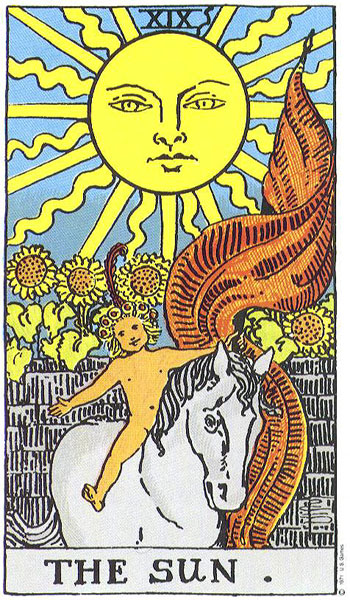
In a widely circulated deck style, the card shows a large sun with a human-like face in the upper portion of the frame. Straight rays alternate with wavy rays, filling much of the sky. Below the sun, a child rides a white horse across open ground. A low wall runs behind them, and tall sunflowers grow above the wall. Smaller sunflowers appear in the lower corners of the image.
You can use this imagery as a quiet exercise. Notice the size of the sun relative to the figures. Notice that the horse is moving forward without a saddle or bridle. Notice that the wall is low enough to look over, not high enough to block the view. Notice that the child is unclothed and unhidden, not posed or guarded.
Each of these observations can suggest a different angle for reflection, but none of them need to be treated as a rule. Different decks show different things. A modern deck may render the sun as a simple circle, a black-and-white starburst, or a hand-drawn emblem. The exercise is the same: name three things you can see, then ask what each one quietly reminds you of.
For example, the low wall might remind you of a boundary that is present but not enclosing. The unclothed child might remind you of a feeling of being seen, in public or in private. The alternating rays might remind you of a pattern that combines straight and curved elements. None of these are predictions. They are invitations to describe, in your own words, what the card brings to mind.
Upright Meaning and Reflection Prompts
Upright, the card's plain meaning is this: clarity, vitality, visibility, and the relief of seeing a situation without unnecessary complication. That is a description, not a verdict. A reading does not tell you that clarity has arrived. It points you toward where to look for it.
Some reflection prompts that fit the upright meaning:
- What is already clear enough to acknowledge or celebrate? - Where in the last week did I see something clearly that I had previously confused? - What single fact, if I wrote it down, would summarize my current situation without drama? - Whose visibility in my life has grown recently, and how have I made space for that? - Where does my body feel more awake than usual, and what is feeding that feeling?
You can answer any of these in writing. A short paragraph is enough. The aim is not to perform insight but to practice it. The Sun, in its upright form, supports a kind of calm noticing.
If you drew this card while thinking about a specific question, write the question at the top of the page and then answer the prompts underneath it. The aim is to see whether the card points at something your own attention already knew.
Reversed Meaning and Reflection Prompts
Reversed, the card shifts its emphasis. A positive development may be partial, delayed, or overshadowed by an unrealistic standard of happiness. This is a careful statement. It does not say the development will not happen. It says the development may be smaller, slower, or hidden behind an expectation that does not match ordinary life.
Common patterns at the reversed Sun include:
- A good result that arrives, but smaller than hoped. - A clear moment of recognition followed by self-doubt. - A tendency to compare a real day to an imagined ideal day. - Visibility without warmth, or warmth without visibility.
Reflection prompts that fit the reversed meaning:
- What small win have I dismissed because it did not look the way I expected? - Where am I holding an inner standard that no real day could meet? - What is partial in my life right now, and what would it mean to honor the partial result? - If a friend described my situation, what would I tell them they had already accomplished? - What would "good enough" look like this week, without losing room for growth?
A reversed Sun is often a card about proportion. It can remind you to measure progress by what is in front of you, not by an imagined peak.
A Grounded Example: Finishing a Small Project
Imagine a reader, Mara, who has spent three months working on a short film in her evenings. She draws the Sun upright on the morning she plans to submit the cut to a local festival. Her first thought is, "This means I will win." That is not what the card says. It is also not what the card can do.
A grounded reading would look like three real questions.
1. **What is already clear?** Mara can name what the film is, who it is for, and which scene she is proudest of. That clarity exists. 2. **What is visible?** She can describe the completed cut, the runtime, and the fact that she has a file ready to upload. 3. **What is the relief?** The relief is that the work exists, that it is done enough to submit, and that she no longer has to wonder whether she will try.
If the festival accepts the film, Mara can record that in her journal as a confirming data point. If it does not, she can record that too. The card did not promise acceptance. It pointed toward seeing what is already in front of her.
If Mara had drawn the reversed Sun, her grounded reading might be: the submission may go out, but the result may be quieter than she hoped. She could record whether she felt disappointed, neutral, or relieved simply to have sent the work. The card's value, in both cases, is that it gives her language to notice her own experience.
Testing Your Interpretation: A Journal Method
A reading only helps you if you can tell, later, whether it was accurate. A simple journal method is to write down three things each time you sit with this card.
**1. What I noticed on the card.** Write three observable details. Example: a sun with a face, a child on a horse, sunflowers in the corners.
**2. What was on my mind.** Write one sentence about the question or mood you brought to the reading. Do not edit it.
**3. What concrete event matches or does not match.** Within 24 to 72 hours, write a short note about a real occurrence. It can be small. The point is to record both matches and disconfirming evidence. If the card promised clarity and your day felt foggy, that is data. If the card promised a delay and something finished early, that is data too.
After two weeks, read your notes back. You will begin to see patterns in how this card lands for you personally. Some readers find that the upright Sun arrives when they have already done the work. Some find that the reversed Sun arrives when they are chasing an ideal that no real week could contain. Your patterns are your own. The card is a mirror, and a mirror is only as honest as the room it stands in.
A useful closing question, after each entry: *What would change my mind about this interpretation?* If you cannot answer it, your reading may be more certain than your evidence. That is worth noting. Treat ambiguity as carefully as you would treat an apparent match. A pattern that survives this kind of note-taking is more useful than a pattern that does not.
Where Tarot Stops and Real Evidence Begins
It is important to say this clearly. **Tarot is not a prediction.** No card can tell you what will happen tomorrow. No card can diagnose a condition, decide a legal question, or pick a financial move. No card can speak for another person's thoughts or intentions.
What the Sun can do is support reflection. It can give you a frame for noticing what is already in front of you. It can slow you down long enough to name what is clear, what is visible, and what is alive in your day. Used that way, it can be a useful companion to journaling, therapy, or quiet thinking. Used as a forecast, it overstates what any symbol can do.
For decisions that affect your health, safety, finances, legal standing, or emotional crisis, please turn to qualified professionals and to the evidence in your own life. A card reading should never replace medical advice, legal counsel, financial planning, or crisis support. If something feels urgent or unsafe, reach out to a trusted person, a clinician, or a local helpline.
Within those limits, the Sun remains a generous card to draw. It asks you to look, to acknowledge, and to let a little more light into the room you are already in.
Share this article