What the Justice Card Shows
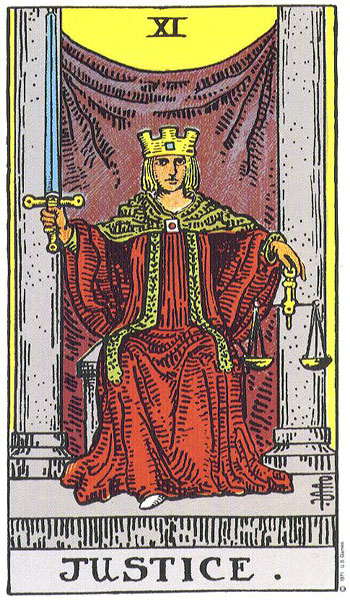
The Justice card from the Major Arcana depicts a figure seated in stillness, often between two pillars, holding a sword upright in one hand and a set of scales in the other. The posture is composed, neither dramatic nor casual. The sword points skyward, which in traditional iconography represents discernment rather than aggression; a blade held vertically can cut cleanly without swinging. The scales are empty or only lightly weighted, suggesting that what the figure will measure has not yet been decided.
The clothing is usually layered, sometimes with a crown or square-motif cloak, and the overall composition is symmetrical. Symmetry matters because it visually invites comparison: one side against the other, claim against claim, fact against fact. There is little motion in the picture, and that quietness is part of the meaning. The card is not depicting a verdict already reached; it is depicting the conditions under which a fair verdict could be reached.
If you are exploring the justice tarot card meaning for the first time, this imagery is a useful starting point. Before any interpretation is layered on, the card itself is showing a tool and a posture: scales for weighing, a sword for separating, and stillness for thinking. These three elements correspond to three habits of mind that any sound decision tends to require.
How to Read Justice Upright
Upright, the Justice card draws attention to evidence, accountability, proportion, and a decision that can withstand careful examination. Each of these words points to a different practical habit.
Evidence means the information you actually have, not the information you wish you had. When Justice appears upright in a reading you are doing for yourself, the natural prompt is: what do I know, and how do I know it? Sources, dates, and firsthand observation matter more than vibes or repetition.
Accountability means being clear about what is yours to answer for. It is not the same as blame, and it is not the same as guilt. Accountability is a structural question: what part of this outcome did my choices contribute to, and what part belongs to other people or to circumstances outside anyone's control?
Proportion is the habit of matching the response to the size of the situation, restoring a kind of balance between the weight of an event and the weight of your reaction. A small error does not require a dramatic confession; a serious harm does not deserve a casual shrug. The scales in the image are a reminder that the weight you put on something should be roughly equal to its actual weight.
A decision that can withstand careful examination is the goal. If a stranger with full information reviewed the decision later, would they reach the same conclusion? That is not a guarantee that you are right; it is a test of whether you have reasons you can explain. The upright Justice card rewards this kind of honesty, not perfection.
How to Read Justice Reversed
When Justice appears reversed in a layout, the card data describes three warning patterns: relevant information may be missing, responsibility may be displaced, or a standard may be applied unevenly. None of these are accusations. They are places to look.
Missing information is the most common of the three. It is easy to decide against a backdrop of incomplete data and only notice the gap after the fact. If you have drawn Justice reversed, a useful first step is to ask what you have not checked. Has a voice been left out? Has a document not been read? Has a number not been verified?
Displaced responsibility is a quieter pattern. It can show up as blaming a system, a mood, a person, or a phase of life for a choice you were part of making. Sometimes the displacement is small, such as telling yourself you were tired and that is why you agreed to something. Sometimes it is large, such as attributing an entire outcome to bad luck. Reversed Justice gently asks: where exactly did my agency enter this situation?
A standard applied unevenly is the third pattern. This is when the same rule is enforced strictly for one party and softly for another, or when a personal preference is dressed up as a principle. Reversed Justice is a prompt to check whether the rule you are using would still make sense if applied to someone you disagree with.
It is worth recording all three possibilities without prejudging which is operating. That is how ambiguity gets respected, and it is the same discipline you would use in any fair-minded decision-making process.
A Grounded Example: Applying Justice to a Work Decision
Suppose you have been asked to take on a small project at work. The deadline is tight, the scope is unclear, and the person making the request is senior. You have a quiet worry that the project is more work than the description suggests.
Read the situation through Justice upright. The scales say: weigh what you know against what you are being asked to commit to. The sword says: separate what is the project from what is the relationship with the senior person. The stillness says: do not answer in the first ten minutes.
You sit down and write two short lists. On one side, the facts you can verify: the deadline, the budget, the named deliverables. On the other, the facts you cannot verify: how the scope may grow, what competing priorities exist, and what the unspoken expectations are. You send a short, polite email asking for clarification on the unknowns. You do not refuse, and you do not accept. You are gathering evidence before you tip the scales.
Now consider what reversed Justice would caution against. You might be tempted to say yes because the senior person is persuasive, displacing responsibility onto politeness. You might be applying a standard unevenly, telling yourself that a busy person should jump at work while you would expect more clarity from a peer. Or you might be deciding with missing information, treating the description as complete when it likely is not.
Notice that none of this requires knowing the future. The point is not whether the project goes well. The point is whether your decision was made in a way that you could reconstruct and explain later. That is the test of upright Justice in a small, real situation, and it is a test you can rerun on most of the ordinary decisions that fill a week.
Reflection Questions to Test in a Journal
Journaling works best when the questions are concrete enough to answer. The following prompts are designed for the Justice card, and each one can be checked against real evidence after the fact. They are written so that your future self, reading the entry in a week or a month, can tell whether you were honest.
1. What are the three facts I am most confident about in this situation, and how did I come to know each one? 2. Where am I applying a rule strictly to myself and loosely to someone else, or the reverse? 3. What would change in my decision if I had to explain it on the record to someone who was not present when I made it? 4. Which part of this outcome is mine to answer for, and which part is not? Be specific. 5. What information am I missing, and what is the smallest step I can take to check whether it is actually missing or just unfamiliar? 6. If a fair third party looked at the same evidence, would they reach the same conclusion? If not, what would they weigh differently? 7. How would I describe the situation if I had to keep my explanation to three sentences? Would it still feel accurate?
These questions work as a loop. You can ask them before a decision, immediately after, and a few weeks later. The value comes from comparing your entries, because the difference between your first and last answer is often more informative than either answer on its own. When your journaling shows that an early confident prediction quietly softened, that change is data, not a failure.
Limits of Interpretation and When to Seek Real Help
Tarot is not a prediction. No arrangement of images on a table can tell you what will happen, what another person is thinking, or whether a choice is fated to succeed. The Justice card is best treated as a structured prompt in your tarot reflection practice, not as a forecast. A clear-eyed reading will often raise more questions than it answers, and that is a sign it is working.
Interpretation also has natural limits. A single card cannot weigh evidence you have not gathered, restore balance in a relationship, or resolve a legal or financial question on its own. Where the stakes are real and the evidence is contested, use qualified professionals: a doctor for medical concerns, a lawyer for legal ones, a financial advisor or planner for money decisions, and crisis services if you or someone you know is in danger. Tarot reflection can sit alongside those resources; it cannot replace them.
When you record a reading, it helps to record disconfirming evidence as carefully as an apparent match. If you drew Justice upright and the situation turned out to involve missing information, that is not a failure of the cards; it is a normal disconfirmation and worth noting. If you drew Justice reversed and the decision held up well, that is also worth noting. The goal of a reflection practice is not to be right every time. The goal is to build a record you can learn from, with both hits and misses treated as evidence about how you actually think.
Bringing Justice into Daily Reflection
The Justice card is unusually portable because its three symbols translate directly into small habits. The scales become a daily check: is the weight I am putting on this situation close to its actual size, or am I inflating it because of mood? The sword becomes a small separating habit: when two things are tangled, such as a person's behavior and your interpretation of it, can you name which is which? The stillness becomes a pause: before answering an email, agreeing to a plan, or committing to a claim, do you have a window of time to look at the evidence first?
None of this requires a ritual, a deck, or a particular setting. A notebook and a willingness to write down what you actually know is enough. Over time, the Justice frame becomes less about the card and more about the posture: composed, proportionate, and accountable to the evidence you can show your work on in everyday decision-making.
If you keep returning to the justice tarot card meaning as a touchstone, the deeper value is not in any single reading. It is in the slow training of a habit of mind that asks for evidence, names what is yours, and weighs claims before acting on them. That habit will serve you whether the card is on the table or not, and it will quietly improve the quality of decisions you rarely have time to revisit.
Share this article